Guiding You Through Life Overseas

Moving to a new country is one of the biggest decisions you’ll ever make — and if that country is Canada, you’re in good company. Every year, hundreds of thousands of people choose Canada for its strong economy, public healthcare, safety, and genuinely welcoming immigration system. But “moving to Canada” isn’t one single process. It’s a collection of different pathways, each with its own rules, costs, and timelines, and choosing the wrong one can cost you months of wasted effort.
This Canada immigration guide breaks down exactly how the Canadian immigration system works in 2026 — from Express Entry and Provincial Nominee Programs to study and work permits — so you can figure out which door is actually open for you, and how to walk through it.
Why People Choose Canada
Canada consistently ranks among the top countries for quality of life, and its immigration system is one of the few in the world built specifically to grow through newcomers rather than just tolerate them. A few reasons people keep choosing it:
- A points-based system (Express Entry) that rewards skills and education rather than just a job offer
- Free public healthcare for permanent residents and citizens
- A direct pathway from studying or working in Canada to permanent residence
- Multiculturalism that’s policy, not just branding — official bilingualism and strong settlement support
- A growing list of Provincial Nominee Programs tailored to local labour needs
Canada Immigration Guide: The Main Pathways to Move to Canada in 2026
There’s no single “Canada visa.” Instead, there are several federal and provincial programs, and most successful applicants combine more than one over time (for example: study permit → work permit → permanent residence).
1. Express Entry
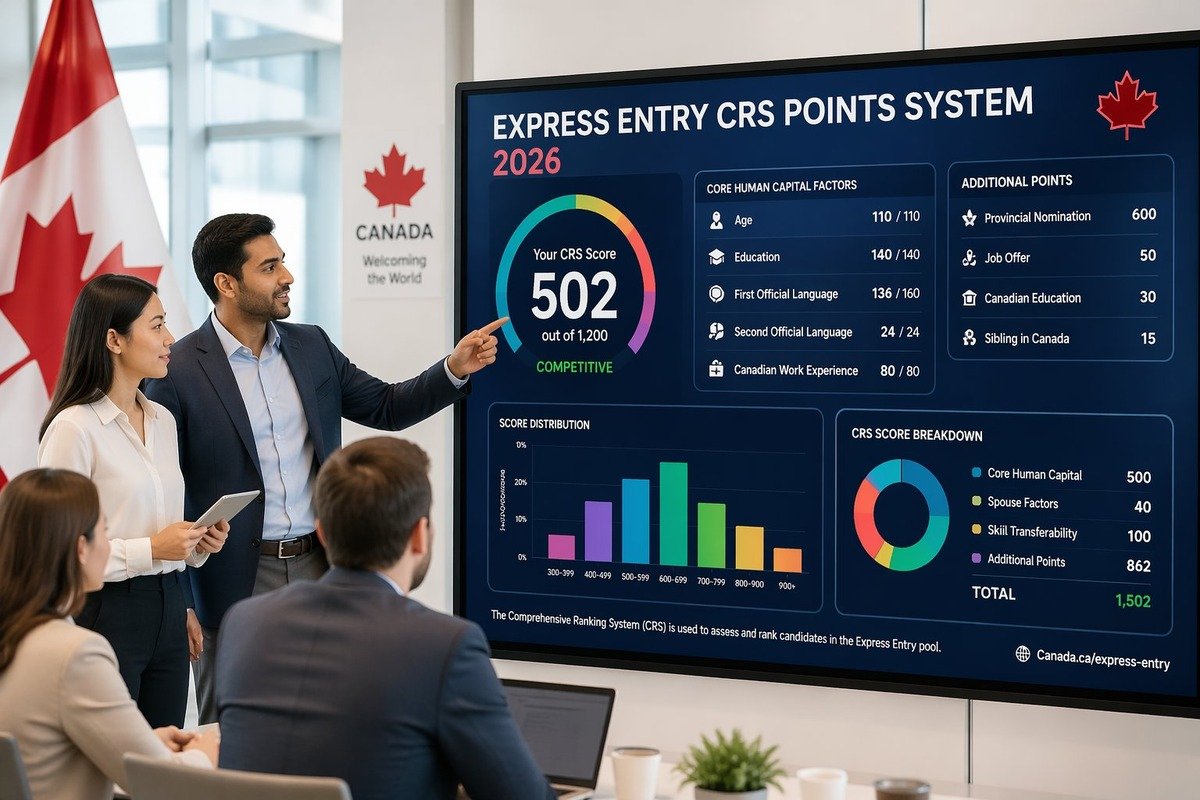
Express Entry is the federal system that manages applications for the Federal Skilled Worker Program, Canadian Experience Class, and Federal Skilled Trades Program. You create a profile, get a Comprehensive Ranking System (CRS) score, and wait to be invited to apply for permanent residence.
In 2026, draw patterns shifted noticeably:
- IRCC has moved away from a strict biweekly draw schedule — gaps between Canadian Experience Class (CEC) draws have stretched close to a month at times.
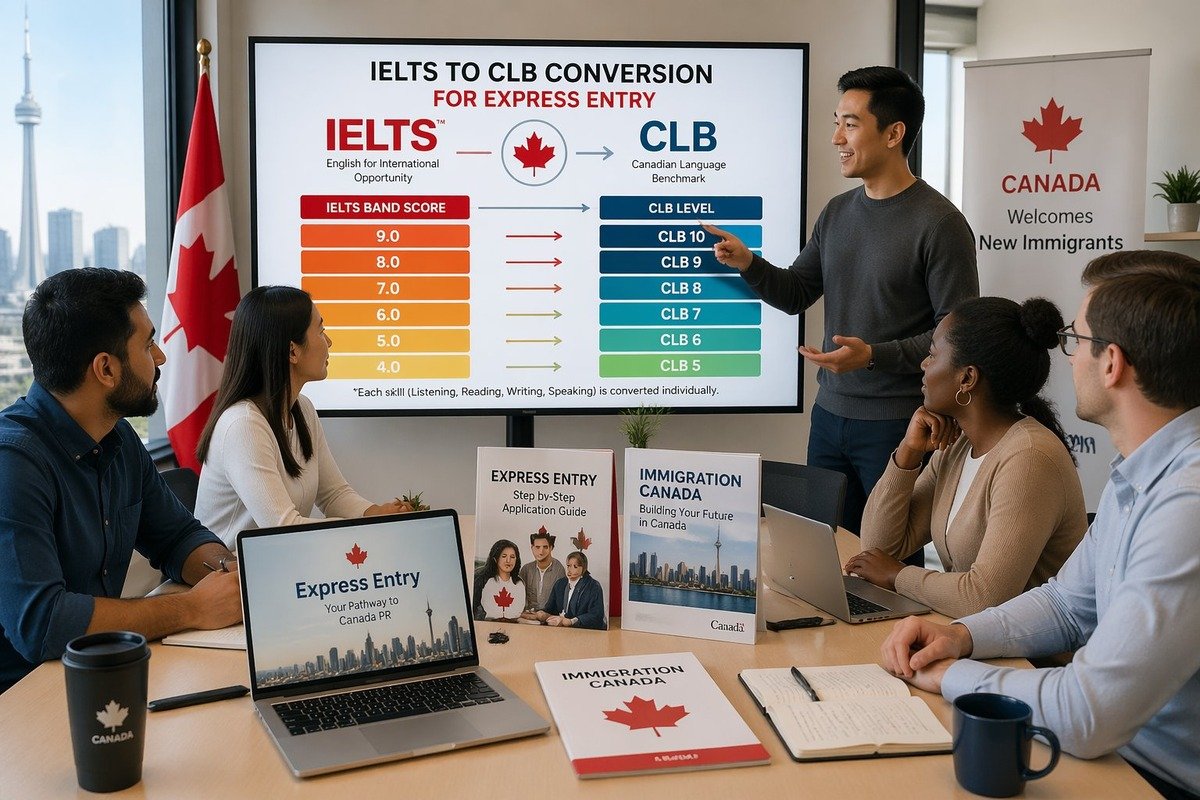
- French-language draws have become the single biggest advantage in the pool. Candidates with French proficiency at Canadian Language Benchmark (CLB) 7 or higher have seen invitations at CRS scores as low as the 380s–440s, far below general draws.
- Healthcare category draws continue for occupations like nursing, medicine, and allied health, with cutoffs roughly in the 460s–510s.
- General CEC and all-program draws have hovered in the mid-500s, though scores fluctuate from round to round.
Practical tip: If you have any French ability, even intermediate, get it tested (TEF Canada or TCF Canada) — it’s currently one of the most reliable ways to lower the CRS score you need.
2. Provincial Nominee Programs (PNP)
Each province (except Quebec, which runs its own system) can nominate candidates who meet its specific labour market needs. A provincial nomination adds 600 CRS points, which is essentially a guaranteed invitation to apply for permanent residence.
2026 brought major changes:
- The federal government allocated 91,500 PNP nominations for 2026 — a 66% jump from 55,000 in 2025. PNPs now make up roughly 38% of all economic immigration to Canada.
- As of March 30, 2026, provinces have exclusive authority to assess a candidate’s “ability to economically establish” and “intent to reside” in the province — IRCC officers can no longer override these provincial decisions on those grounds, giving provincial nominations more weight than before.
- Ontario received the largest 2026 allocation increase (14,119 nominations, up from 10,750).
- British Columbia raised its Skills Immigration application fee to $1,750 (from $1,475) and opened a new Rural/Remote Health Support stream.
Practical tip: Apply directly to a provincial stream that matches your occupation or region if your CRS score isn’t competitive for a general federal draw — it’s often the faster route to permanent residence.
3. Study Permits
For many newcomers, studying in Canada is the first step toward a long-term future there. But 2026 is a tighter year for international students:
- A national cap of 309,670 new study permit applications applies for 2026 (requiring a Provincial/Territorial Attestation Letter, or PAL/TAL, in most cases), per IRCC’s official 2026 allocation notice.
- IRCC expects to issue about 408,000 total study permits in 2026 (155,000 new, 253,000 extensions) — a 7% drop from 2025.
- Good news for graduate students: as of January 1, 2026, master’s and doctoral students at public designated learning institutions are exempt from the PAL/TAL requirement.
- Ontario, Quebec, and British Columbia receive the largest shares of the national cap.
Costs to budget: $150 study permit application fee + $85 biometrics fee, plus proof of funds, tuition, and a Letter of Acceptance from a Designated Learning Institution (DLI).
4. Work Permits
Canada’s work permit system splits into two tracks:
- International Mobility Program (IMP) — LMIA-exempt permits (includes intra-company transfers, CUSMA/trade agreement workers, post-graduation work permits, and significant-benefit categories). IMP admissions are targeted at 170,000 for 2026, a 32% increase.
- Temporary Foreign Worker Program (TFWP) — requires an employer-obtained Labour Market Impact Assessment (LMIA). Only 60,000 spots are allocated in 2026, reflecting Canada’s shift toward prioritizing LMIA-exempt pathways.
Notable 2026 changes:
- Intra-Company Transfer rules now require the sponsoring company to show revenue-generating operations in at least two countries — new Canadian start-up entities no longer qualify.
- “Significant Benefit” (C10) work permits now require a stricter “demonstrable impact” standard.
- Post-Graduation Work Permit (PGWP) eligible program lists are frozen for 2026 — no additions or removals.
Costs to budget: $155 base work permit fee (open work permit holder fee is an additional $100 in applicable categories), plus biometrics where required.
5. Visitor Visas and Super Visas
If you’re not ready for a permanent move, a visitor visa (Temporary Resident Visa) lets you explore Canada, visit family, or attend short business events. Parents and grandparents of Canadian citizens or permanent residents can apply for a Super Visa, allowing stays of up to 5 years per entry without needing to renew status.
Eligibility at a Glance
| Pathway | Best for | Key requirement |
|---|---|---|
| Express Entry | Skilled workers with strong education/experience | Competitive CRS score |
| PNP | Workers with a job offer or ties to a specific province | Meet provincial stream criteria |
| Study Permit | International students | Letter of Acceptance + proof of funds |
| Work Permit (IMP) | Workers covered by trade agreements, transfers, etc. | LMIA-exempt category |
| Work Permit (TFWP) | Workers with a Canadian job offer | Employer-approved LMIA |
How to Start Your Canadian Immigration Journey
- Assess your profile — Use the official CRS calculator to see where you stand for Express Entry.
- Check language scores first — IELTS or CELPIP for English, TEF/TCF for French. Language points carry significant weight in 2026’s draws.
- Research provincial streams that match your occupation, especially if your CRS score is below current cutoffs.
- If studying, confirm your school is a DLI and check whether your province still has PAL/TAL capacity under the 2026 cap.
- If working, confirm whether your role is LMIA-exempt — this affects both cost and processing time significantly.
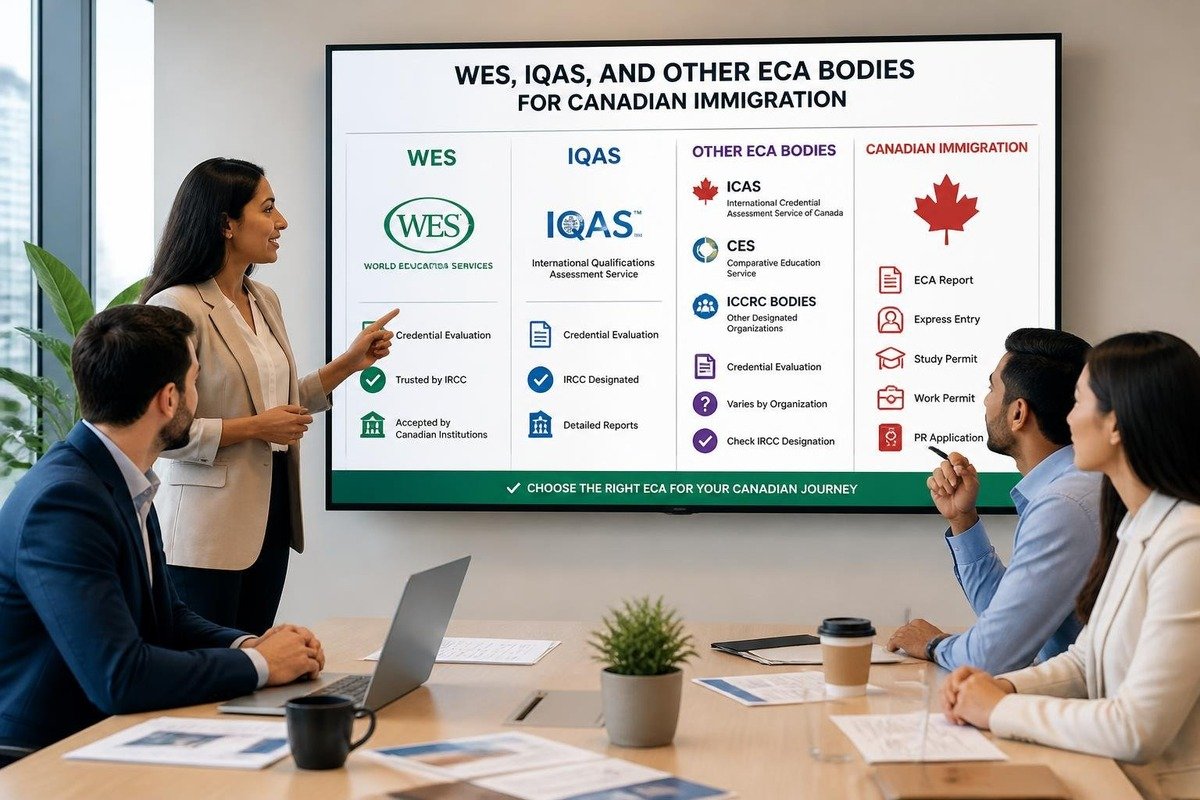
- Get your documents ready early: ECA (Educational Credential Assessment), proof of funds, police certificates, and medical exams all take time.
What to Budget For in 2026
- Study permit: $150 + $85 biometrics
- Work permit: $155 (+ $100 for open work permit holder fee, where applicable)
- Express Entry / Federal High Skilled / PNP economic application: $990 per principal applicant
- Right of Permanent Residence Fee (RPRF): $600
- Family sponsorship: $570
- Business immigration categories: $1,895
These are government fees only — biometrics, language tests, ECA, and medical exams are separate costs.
Common Mistakes to Avoid
- Waiting for a “perfect” CRS score instead of pursuing a provincial nomination that could fast-track you
- Assuming all study programs lead to a Post-Graduation Work Permit — always confirm DLI and program eligibility first
- Underestimating biometrics and processing delays when planning move dates
- Applying for TFWP-based work permits without confirming your employer has a valid, recent LMIA
Final Thoughts
This Canada immigration guide comes down to one idea: Canada’s immigration system rewards people who do their homework. The pathways are real, but in 2026 they’re more selective and more provincially driven than they were even a year or two ago. Whether you’re eyeing Express Entry, a provincial nomination, a study permit, or a work permit, the fastest route is usually the one that matches your specific profile — not the most popular one.
If you’re not sure where you fit yet, that’s exactly where to start: get an honest read on your CRS score, your language test results, and your provincial options before you spend money on an application.
Frequently Asked Questions
What is the easiest way to immigrate to Canada in 2026?
There’s no universally “easiest” path — it depends on your profile. Candidates with strong French proficiency are currently seeing the lowest CRS cutoffs in Express Entry, while Provincial Nominee Programs are often faster for those with a job offer or in-demand occupation.
How much does it cost to immigrate to Canada through Express Entry?
Budget around $990 for the application fee per principal applicant, plus $600 for the Right of Permanent Residence Fee, on top of language testing, ECA, and medical exam costs.
Can international students get permanent residence after graduating?
Yes — many graduates use a Post-Graduation Work Permit to gain Canadian work experience, which can then qualify them for the Canadian Experience Class under Express Entry.
Has the Provincial Nominee Program gotten easier in 2026?
In some ways, yes. Allocations increased by 66% to 91,500 nominations, and provinces now have final say over key eligibility assessments as of March 2026, making provincial routes more predictable.
Is it harder to get a work permit in Canada now?
LMIA-based (TFWP) work permits have fewer spots in 2026, but LMIA-exempt (IMP) categories increased significantly, so the difficulty depends heavily on which category applies to you.
Do I need a job offer to apply through Express Entry?
No. Express Entry is points-based and doesn’t require a job offer, though having one can add CRS points.
This post is for informational purposes only and does not constitute legal or immigration advice. Fees, caps, and program rules are subject to change — always verify current details at canada.ca before applying.