How to Convert IELTS Scores to CLB for Express Entry
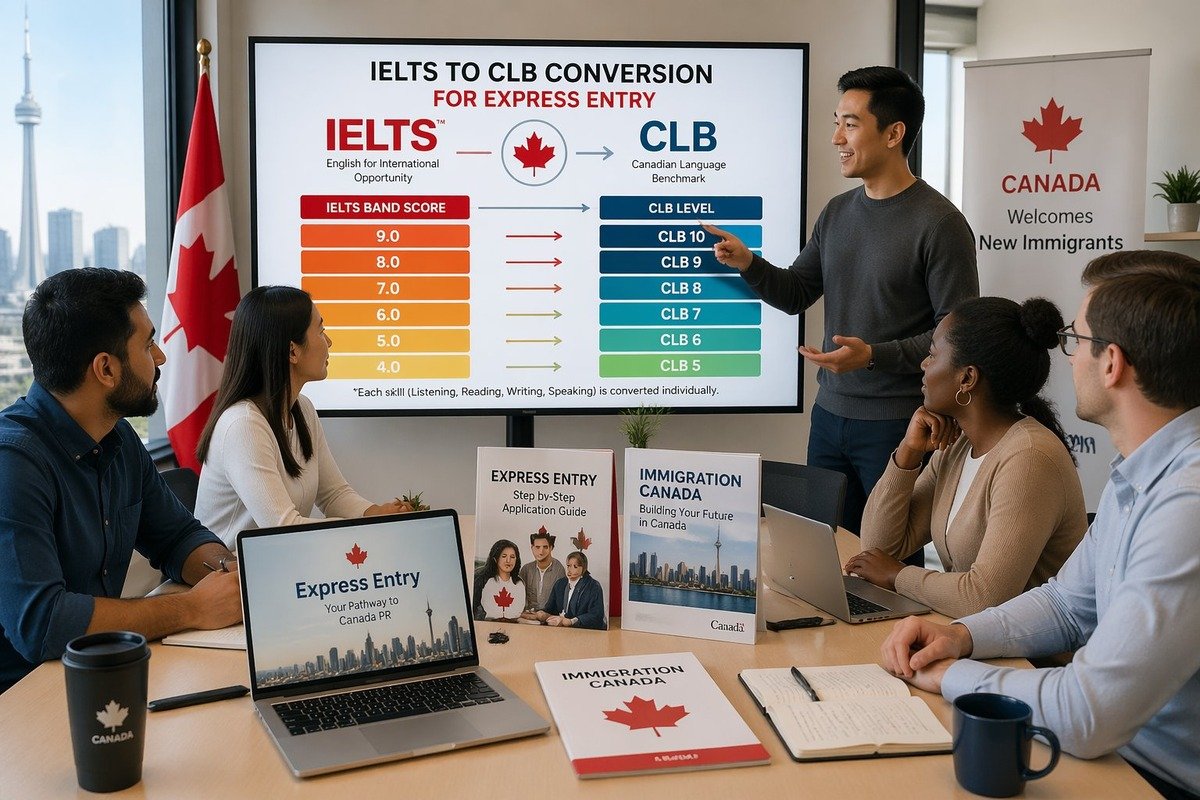
When you receive your IELTS results, you’ll see four band scores — one each for Listening, Reading, Writing, and Speaking. But when you go to fill in your Express Entry profile, IRCC doesn’t ask for your IELTS bands. It asks for your Canadian Language Benchmark (CLB) level.
This is where many applicants get confused. CLB is not a test you take. It’s a national measurement framework that IRCC uses to standardise language scores across all approved tests. To enter your language results correctly, you need to convert each of your four IELTS scores into its corresponding CLB level using IRCC’s official equivalency chart — and you need to do this skill by skill, not from your overall band score.
This guide walks through exactly how to do that conversion, explains why each skill matters individually, and shows you what the CLB targets mean for your CRS score and program eligibility.
The one rule that catches most people out
Before anything else: Canada does not use your overall IELTS band score for immigration purposes.
Your overall band is an average IELTS calculates to summarise your performance. IRCC ignores it entirely. Instead, it takes each of your four individual skill scores — Listening, Reading, Writing, and Speaking — and converts each one independently into a CLB level. Your eligibility and CRS points are then determined by those four CLB levels separately.
This matters because a high overall band can mask a weak individual skill. If you scored 7.5 overall but your Reading was 5.5, your CLB for Reading is 6 — and CLB 6 in even one skill disqualifies you from the Federal Skilled Worker Program’s CLB 7 minimum, regardless of how well you performed in the other three.
The full IELTS General Training to CLB conversion table
Each skill has its own conversion thresholds. Listening in particular requires a notably higher band score to reach the same CLB level as the other three skills — a quirk that catches many applicants by surprise.
Listening
| IELTS band | CLB level |
|---|---|
| 4.5 | CLB 4 |
| 5.0 | CLB 5 |
| 5.5 | CLB 6 |
| 6.0 | CLB 7 |
| 7.5 | CLB 8 |
| 8.0 | CLB 9 |
| 8.5 | CLB 10 |
Reading
| IELTS band | CLB level |
|---|---|
| 3.5 | CLB 4 |
| 4.0 | CLB 5 |
| 5.0 | CLB 6 |
| 6.0 | CLB 7 |
| 6.5 | CLB 8 |
| 7.0 | CLB 9 |
| 8.0 | CLB 10 |
Writing
| IELTS band | CLB level |
|---|---|
| 4.0 | CLB 4 |
| 5.0 | CLB 5 |
| 5.5 | CLB 6 |
| 6.0 | CLB 7 |
| 6.5 | CLB 8 |
| 7.0 | CLB 9 |
| 7.5 | CLB 10 |
Speaking
| IELTS band | CLB level |
|---|---|
| 4.0 | CLB 4 |
| 5.0 | CLB 5 |
| 5.5 | CLB 6 |
| 6.0 | CLB 7 |
| 6.5 | CLB 8 |
| 7.0 | CLB 9 |
| 7.5 | CLB 10 |
Source: IRCC official language equivalency charts, Canada.ca
The Listening anomaly: why you need a much higher band
Look at the Listening column carefully. To reach CLB 8 in Listening, you need a band of 7.5 — but CLB 8 in Reading, Writing, or Speaking requires only 6.5. To reach CLB 9 in Listening, you need 8.0, whereas the other three skills only require 7.0.
This is the most common source of unexpected shortfalls. An applicant targeting CLB 9 across the board who trains to IELTS 7.0 in all four skills will hit CLB 7 in Listening — not CLB 9 — and lose significant CRS points as a result.
If CLB 9 is your target, you need IELTS 8.0 in Listening specifically, alongside 7.0 in the other three skills.
Step-by-step: how to convert your scores
- Get your four individual IELTS General Training band scores from your Test Report Form.
- Look up each score in the corresponding skill table above.
- Note the CLB level for each of the four skills.
- Your program eligibility is determined by your lowest CLB score across the four skills.
- Your CRS points are calculated using each skill’s CLB level individually — higher scores in any skill still count, even if one skill is weaker.
Worked example
Suppose your IELTS General Training results are:
- Listening: 7.5
- Reading: 6.5
- Writing: 6.5
- Speaking: 7.0
Converting each:
- Listening 7.5 → CLB 8
- Reading 6.5 → CLB 8
- Writing 6.5 → CLB 8
- Speaking 7.0 → CLB 9
Your program eligibility CLB is CLB 8 (the lowest of the four). You meet the CLB 7 minimum for the Federal Skilled Worker Program, and you exceed it. Your CRS points are then calculated based on those individual CLB levels — the CLB 9 in Speaking earns slightly more points than a CLB 8 would, even though your overall eligibility level is CLB 8.
Second example: a hidden trap
- Listening: 5.5
- Reading: 6.5
- Writing: 6.5
- Speaking: 6.5
Converting:
- Listening 5.5 → CLB 6
- Reading 6.5 → CLB 8
- Writing 6.5 → CLB 8
- Speaking 6.5 → CLB 8
Your program eligibility CLB is CLB 6 — you do not meet the CLB 7 minimum for FSWP, even though three of your four skills are at CLB 8. One weak skill in Listening disqualifies the entire profile from that program threshold. This is precisely why understanding the Listening anomaly matters before you sit the test.
What CLB levels mean for your program eligibility
Different Express Entry streams have different minimum CLB requirements:
Federal Skilled Worker Program (FSWP) All four skills must be CLB 7 or above. This corresponds to IELTS 6.0 in Reading, Writing, and Speaking, and IELTS 6.0 in Listening.
Canadian Experience Class (CEC) Requirements vary by your NOC TEER category:
- TEER 0 or 1 jobs: CLB 7 in all four skills
- TEER 2 or 3 jobs: CLB 5 in all four skills
Federal Skilled Trades Program (FSTP)
- Speaking and Listening: CLB 5 (IELTS 5.5 in Listening, 5.0 in Speaking)
- Reading and Writing: CLB 4 (IELTS 3.5 in Reading, 4.0 in Writing)
Meeting the minimum gets you into the pool. But meeting the minimum alone rarely results in an invitation — CRS cut-off scores in recent draws have typically been well above what the minimum CLB produces. Which brings us to the most strategically important target.
Why CLB 9 is the number worth aiming for
CLB 9 is the language benchmark that meaningfully changes your CRS position. For applicants with a single official language (English), reaching CLB 9 in all four skills earns the maximum available language points in the CRS. Dropping even one skill to CLB 8 costs points. The difference between CLB 8 across the board and CLB 9 across the board can be 20–30 CRS points or more depending on your profile — which, in a competitive Express Entry pool, is the difference between receiving an Invitation to Apply and waiting for the next draw.
To reach CLB 9 across all four skills, you need:
- Listening: 8.0
- Reading: 7.0
- Writing: 7.0
- Speaking: 7.0
Note that Listening is again the outlier. Many applicants find it easier to reach 7.0 in Reading, Writing, and Speaking than to push Listening up to 8.0. Targeted Listening practice — particularly with Sections 3 and 4 of the IELTS, which feature longer academic and professional monologues — is where most CLB 9 candidates need to focus.
If you also have French proficiency, adding a French test (TEF Canada or TCF Canada) that demonstrates CLB/NCLC 5 or higher earns additional CRS points for bilingualism — a meaningful boost that some applicants underutilise.
Two years: the validity window to manage
Your IELTS results are valid for exactly two years from the date of your test. They must be valid at two separate points: when you create your Express Entry profile, and when you submit your actual Application for Permanent Residence.
Since Express Entry processing times can vary, applicants who sit their test early and then spend months in the pool risk their results expiring before they receive an ITA or before their PR application is processed. If your test expires while you’re in the pool, you’ll need to retest before you can apply — and if results expire after you’ve been invited to apply, you’ll face a refused application.
The practical advice is to calculate your expected timeline. If your results will expire within the likely processing window, consider timing your retest to refresh them, or build enough buffer by sitting the test closer to when you intend to apply.
One important note on IELTS One Skill Retake
IELTS offers a product called the One Skill Retake (OSR), which lets test-takers resit a single section of the exam rather than the full test. IRCC does not accept OSR results for Express Entry. You must have a complete, standard IELTS General Training result. If you attempted to improve a weak skill using OSR, those results cannot be used for your Express Entry profile — you would need to resit the full exam.
Key takeaways
Four things to keep in mind when working with your IELTS-to-CLB conversion:
Your overall IELTS band score is irrelevant for immigration — convert each skill individually using the official IRCC charts.
Listening requires a higher band score to reach the same CLB level as the other three skills. At CLB 9, you need IELTS 8.0 in Listening versus 7.0 in the other skills.
Your program eligibility is set by your lowest CLB skill. One weak skill pulls your entire eligibility floor down, regardless of performance elsewhere.
CLB 9 across all four skills is the strategic target for Express Entry competitiveness, not just the CLB 7 minimum for program entry.
This post is for informational purposes only and does not constitute legal or immigration advice. IRCC conversion charts and program minimums are subject to change — always verify current requirements at canada.ca before applying.