What Happens During an Immigration Medical Exam for Canadian PR?
The immigration medical exam is one of the most misunderstood steps in the Canadian permanent residence process. Most applicants are not sure what it involves, whether a health condition will affect their outcome, or when they need to do it. Some put it off because they are anxious about it. Others do it too early and have to repeat it.
This guide explains exactly what the exam involves, who must do it and when, what the tests check for, how results are submitted, and — critically — under what circumstances a health finding can affect your admissibility.
What the immigration medical exam is — and who performs it
The Immigration Medical Examination (IME) is a structured health assessment conducted by a panel physician — a doctor specifically authorised by IRCC to perform immigration medicals. You cannot use your own family doctor, a walk-in clinic, or a hospital for this examination. The doctor must be on IRCC’s official list of approved panel physicians.
Panel physicians operate in most countries worldwide. You find one using the “Find a Panel Physician” tool on the Government of Canada website — navigate to canada.ca, search “find panel physician,” and filter by your country and city. Contact the clinic directly to book an appointment; you cannot book through IRCC.
The panel physician’s role is to conduct the examination and submit results directly to IRCC. They do not make the final medical admissibility decision — only IRCC medical officers do that. The panel physician examines you, documents findings, and transmits everything electronically through a secure system called eMedical.
2025 update: upfront medical exams now required for Express Entry
As of August 21, 2025, IRCC introduced a significant change for Express Entry applicants: if you are applying for permanent residence through Express Entry on or after that date, you must complete your medical examination upfront — before or at the time of submitting your PR application — rather than waiting for IRCC to request it during processing.
This change applies to:
- The principal applicant
- All family members listed on the PR application, even those who are not coming to Canada
This change does not affect PR applications submitted before August 21, 2025, or non-Express Entry PR streams, which continue to follow the existing process where IRCC requests the exam during processing.
The practical implication: Express Entry applicants should book their IME appointment as soon as they receive an Invitation to Apply, or ideally sooner. Panel physician availability varies significantly by country and season — in some regions, appointments can be booked within days; in others, waiting times are several weeks.
Who must have a medical exam
All permanent residence applicants must complete an immigration medical exam, with one important scope: every family member listed on your PR application must also be examined — even if they are not accompanying you to Canada.
This means that if your spouse or child is staying in your home country while you immigrate, they still need to see an IRCC-approved panel physician in that country and be found medically admissible before your PR application can be approved.
For children, the required tests differ by age:
- Under 11: Physical examination only. Chest X-ray is not required.
- 11 and older: Physical examination plus chest X-ray.
- Blood and urine tests are required at certain age thresholds (typically from age 15 onward for blood tests related to syphilis, and from age 5 for urinalysis).
What happens step by step during the appointment
A standard immigration medical exam appointment typically takes between one and three hours, depending on your age, the tests required, and how busy the clinic is. Here is what to expect, in sequence:
Identity verification. When you arrive, clinic staff ask for your passport or national identity document. Your photograph is taken for IRCC’s records. If you are directed to a separate facility for an X-ray or blood draw, you will need to show your identification there as well.
Medical history questionnaire. The panel physician — or clinic staff on the physician’s behalf — completes a detailed medical history questionnaire with you. This covers existing or past medical conditions, current medications, allergies, previous surgeries, and relevant family history. You are asked about conditions including tuberculosis, HIV, and mental health history.
Be honest and complete during this step. IRCC guidance is explicit: if you do not disclose a known condition, processing can take longer — and if a condition is discovered later that should have been disclosed, it can trigger a misrepresentation concern. Disclosing a condition does not automatically make you inadmissible; most conditions do not.
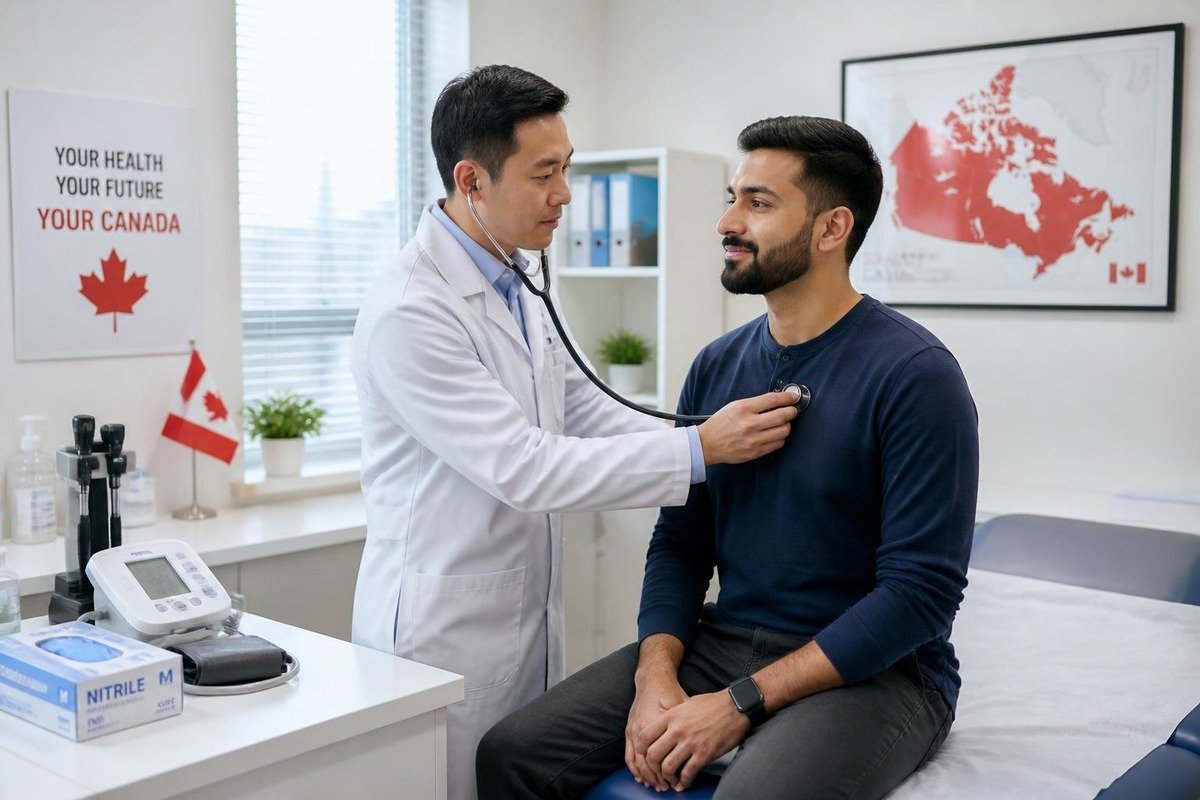
Physical examination. The doctor conducts a standard physical assessment. This typically covers:
- Height and weight measurements
- Vision assessment
- Cardiovascular system (heart rate, blood pressure, heart sounds)
- Respiratory system (lung sounds, breathing)
- Abdomen (organ size, tenderness)
- Skin assessment (for visible conditions)
- Neurological and musculoskeletal assessment
- Lymph nodes
The genital and rectal areas are not examined. This is stated explicitly in IRCC’s official guidance. If you have questions or feel uncomfortable with any part of the exam, you can ask the physician to stop and explain your concerns.
Chest X-ray. Required for all applicants aged 11 and older. This screens primarily for tuberculosis (TB), which is one of IRCC’s key public health concerns. The X-ray is usually taken at the clinic or at a connected radiology facility. If you are pregnant, inform the panel physician — they will assess whether the X-ray can be deferred and discuss this with IRCC.
Blood tests. Required for most applicants aged 15 and older. The standard blood panel tests for syphilis. If your medical history or physical exam indicates a need for further investigation, additional blood tests may be ordered.
Urinalysis. A urine sample is collected and tested, typically from age 5 onward. Standard urinalysis screens for infections and other conditions that may be relevant to health admissibility.
Vaccination review. Panel physicians review your vaccination records. You are not required to bring vaccination documentation, but bringing it can prevent unnecessary repeat immunisations. If records are unavailable, the physician may order blood tests to assess immunity levels, or recommend specific vaccinations. This is advisory rather than a strict requirement for the IME itself, though IRCC’s vaccination requirements are informed by Health Canada public health recommendations.
Document issued to you. At the end of the appointment, the physician gives you a document confirming you had the examination — typically an information sheet with your photo and a case or reference number. Keep this document. It is your proof of the examination and contains the number you need to track your results.
What happens after the exam
The panel physician submits your results directly to IRCC electronically through the eMedical system. You do not need to send anything to IRCC yourself. Results are typically uploaded within five to ten business days of the appointment, depending on laboratory processing times.
IRCC medical officers then review the results. If no concerns are identified, processing continues without any communication to you about the medical outcome — silence means no issues.
If the medical officer identifies a potential concern, IRCC contacts you in writing. This communication is called a Procedural Fairness Letter (PFL). It explains the specific finding, the potential admissibility concern, and gives you an opportunity to respond — typically by providing additional medical information, specialist reports, or evidence of treatment.
A PFL is not a refusal. It is an opportunity to address the concern. Many applicants who receive a PFL successfully resolve the issue and receive positive admissibility determinations.
The three grounds of medical inadmissibility
IRCC assesses medical admissibility against three criteria:
Danger to public health. Active tuberculosis is the primary condition in this category. Untreated syphilis is also in scope. If active TB is found, you are not immediately refused — IRCC works with public health authorities and applicants to establish a treatment pathway. Most TB cases can be addressed through treatment and follow-up without resulting in permanent inadmissibility.
Danger to public safety. Serious, uncontrolled conditions that may lead to unpredictable or harmful behaviour. This is a narrow and rarely invoked category covering specific unmanaged mental health conditions and certain substance use disorders.
Excessive demand on health or social services. This is the most commonly triggered inadmissibility ground for PR applicants with ongoing health needs. IRCC assesses whether your condition would be likely to cause health or social services costs that exceed a specific threshold over a five-year period.
The excessive demand threshold for 2025 is set at $135,810 over five years — or approximately $27,162 per year. This figure is updated annually. Conditions that require ongoing medication, specialist care, or support services are assessed against this threshold. A condition is not automatically inadmissible just because it requires treatment — it must be likely to exceed the threshold.
Who is exempt from the excessive demand assessment:
- Spouses and common-law partners of Canadian citizens or permanent residents
- Dependent children of Canadian citizens or permanent residents
- Refugees and protected persons
- Convention refugees
If you fall into one of these categories, you cannot be found inadmissible on excessive demand grounds — only on public health or public safety grounds.
Common conditions and how they are typically handled
Tuberculosis (TB). If your chest X-ray suggests TB, IRCC will require further testing and specialist evaluation. Active TB makes you inadmissible until treated. Latent TB (not active, not contagious) typically does not result in inadmissibility but may require medical surveillance after landing. Many applicants with latent TB are approved and receive instructions to follow up with public health authorities after arrival.
HIV. A positive HIV result is not automatically inadmissible. IRCC assesses whether the ongoing treatment costs would exceed the excessive demand threshold. With modern antiretroviral therapy, HIV-positive applicants are frequently found admissible, particularly when they can demonstrate private insurance coverage or that costs will be below threshold.
Diabetes and chronic conditions. Assessed on a case-by-case basis against the excessive demand threshold. Applicants with well-managed conditions and lower-cost treatment profiles are generally found admissible.
Mental health conditions. Most mental health conditions do not result in inadmissibility. The public safety ground is narrow and applies only to serious, uncontrolled conditions. Disclosure and documentation of ongoing treatment actually supports admissibility by showing the condition is managed.
Disability. Applicants with physical or intellectual disabilities are assessed against the excessive demand threshold. This has historically been a controversial area of Canadian immigration policy — IRCC’s excessive demand assessment framework has been the subject of legal challenges and policy reviews, particularly for families with disabled children. Consult an RCIC or immigration lawyer if this applies to your situation.
How much the exam costs
IRCC does not regulate panel physician fees. Costs vary by country, city, and the specific tests required for your age and history. General ranges in Canada:
- Adults (18+): approximately $450–$700 CAD including all standard tests
- Children: approximately $250–$400 CAD depending on age and tests required
Outside Canada, fees vary significantly by country and are typically quoted in local currency.
Additional costs apply if specialist referrals, additional laboratory tests, or follow-up appointments are needed. All costs are paid directly to the panel physician at the time of the exam — IRCC does not reimburse these fees.
Provincial health insurance does not cover immigration medical examinations.
Validity period and what happens if it expires
Your IME results are valid for 12 months from the date of examination. You must land in Canada as a permanent resident within that 12-month window, or you may need to have the examination repeated.
For Express Entry applicants under the new upfront model, this means timing your examination carefully. If you complete the exam and then experience delays in processing — or if you receive an ITA but don’t yet have all other documents ready — your medical results may expire before your PR is finalised. In that case, IRCC will request a repeat examination.
If you previously completed an IME within five years of submitting a new immigration application, include your IME number (or unique medical identifier number) from the previous exam in your new application. This can allow IRCC to assess whether a full repeat exam is needed.
What to bring to your appointment
Bring the following to your IME appointment:
- Valid passport or national identity document (required)
- Your IRCC medical exam request letter or IME instructions (if IRCC has already issued one — Express Entry upfront applicants may book without this)
- Your complete vaccination records, if available
- A list of all current medications with dosages
- Any relevant medical records: specialist reports, previous test results, surgical history, diagnostic imaging reports
- Four recent passport-style photographs, if the clinic requires them — confirm in advance
Do not fast before the appointment. The physical examination does not require fasting, and eating normally beforehand is recommended.
Key takeaways
Every PR applicant — and every family member listed on the application, whether accompanying or not — must complete an immigration medical exam with an IRCC-approved panel physician. Your own doctor cannot perform the examination.
As of August 21, 2025, Express Entry applicants must complete the IME upfront, before or at the time of submitting the PR application. Non-Express Entry streams follow the existing process where IRCC requests the exam during processing.
The exam covers identity verification, a medical history questionnaire, a physical examination, a chest X-ray (for those aged 11+), blood tests (for those aged 15+), and urinalysis. It typically takes one to three hours. The genital and rectal areas are not examined.
Panel physicians submit results directly to IRCC through the eMedical system within five to ten business days. You do not send anything yourself.
Medical inadmissibility arises on three grounds: danger to public health, danger to public safety, or excessive demand on health or social services. The 2025 excessive demand threshold is $135,810 over five years. Spouses, dependent children, refugees, and protected persons are exempt from excessive demand assessment.
Most health conditions do not result in inadmissibility. If IRCC has concerns, they issue a Procedural Fairness Letter — not an immediate refusal. You have the opportunity to respond with additional information.
Results are valid for 12 months. If you do not land as a PR within that period, a repeat exam may be required.
This post is for informational purposes only and does not constitute legal or immigration advice. IRCC medical requirements, costs, and inadmissibility thresholds are subject to change — always verify current requirements at canada.ca. If a health condition may affect your application, consult a Regulated Canadian Immigration Consultant (RCIC) or immigration lawyer before applying.