Common-Law Partnership vs Conjugal Sponsorship: What Is the Difference for Canadian Immigration?
Canada’s family sponsorship program recognises three types of intimate partnerships: legally married spouses, common-law partners, and conjugal partners. For most people, the first two categories are straightforward. The third — conjugal partnership — is less understood, frequently misapplied, and carries the highest refusal rate of any family class category.
If you and your partner are not married and have not lived together for a continuous year, you may be wondering whether conjugal sponsorship is your answer. In most cases, it is not — and applying under the wrong category is a direct path to refusal. This post explains what each category actually means, where the line between them falls, what evidence each requires, and what happens when your circumstances genuinely require the conjugal stream. Common-Law Partnership vs Conjugal Sponsorship
The three relationship categories in Canadian immigration
Under the Immigration and Refugee Protection Act, IRCC recognises relationships in three ways for sponsorship purposes:
Spouse — a person you are legally married to. The marriage must be valid under the law of the jurisdiction where it occurred and recognised under Canadian law. IRCC does not recognise proxy marriages, telephone marriages, internet marriages, or marriages by fax, unless both people were physically present at the ceremony. This category applies equally to opposite-sex and same-sex couples.
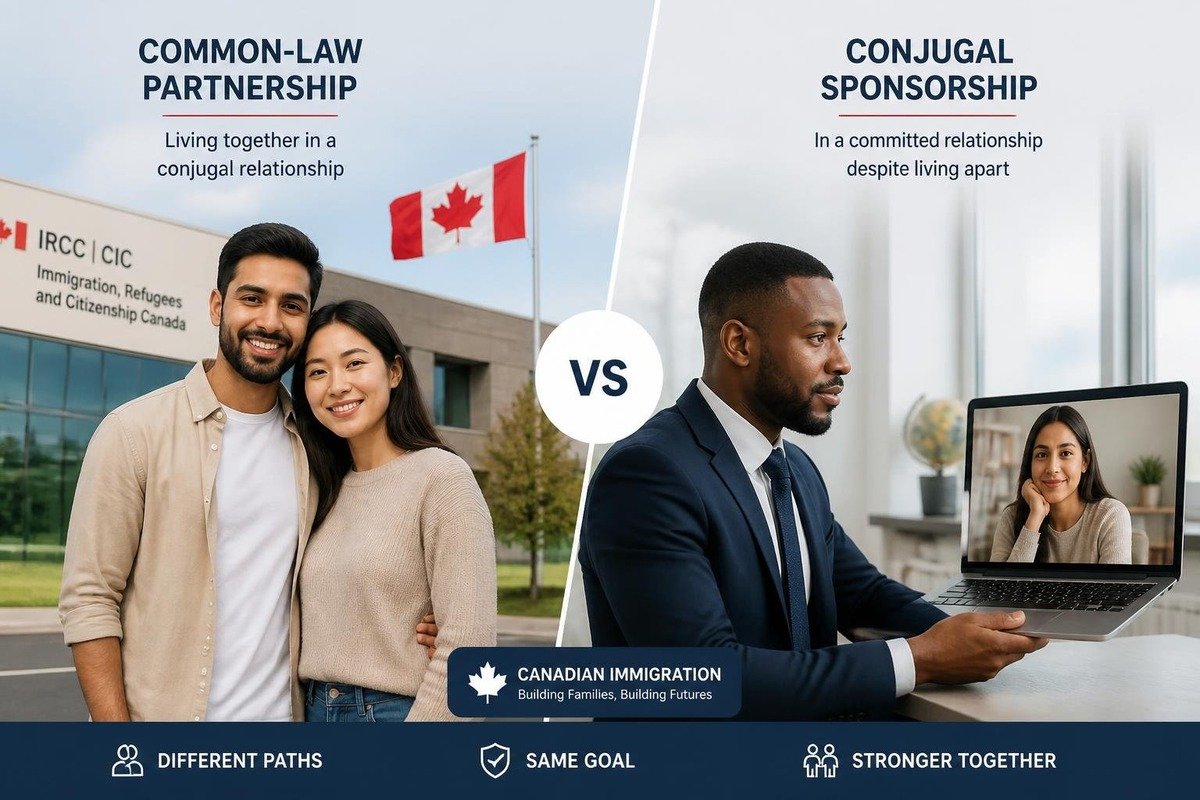
Common-law partner — a person who has lived with you in a conjugal relationship for at least 12 consecutive months, without a formal marriage. Under the IRPA, common-law partners have the same legal status as spouses for immigration purposes. The 12 months must be continuous — meaning you were living together as a household, not visiting or in a long-distance relationship.
Conjugal partner — a person you have been in a committed, marriage-like relationship with for at least one year, but whom you have been unable to live with or marry due to genuine barriers that are beyond your control. This is the most restricted category and exists specifically for situations where neither marriage nor cohabitation was possible.
All three categories apply equally to same-sex and opposite-sex couples. The choice between them is not a preference — it is determined by the actual facts of your relationship.
Common-law partnership: what it actually requires
The legal threshold for common-law status in Canadian immigration is 12 consecutive months of cohabitation in a conjugal relationship. Every word in that definition carries weight.
12 consecutive months means an unbroken period of living together. Short gaps — a work trip, a holiday, a medical stay — do not necessarily break the period, provided the absence was temporary and the shared home remained intact. However, a period where one partner moved out, returned to their home country, or maintained a separate primary residence does not count toward the 12 months. The clock resets.
Cohabitation means sharing a home as a household — not visiting, not staying for extended periods while maintaining a separate primary address, and not living in separate units in the same building. The home you share must genuinely be the primary residence for both of you.
Conjugal relationship means the relationship has the essential characteristics of marriage: emotional commitment, exclusivity, shared finances, physical intimacy, and mutual support. IRCC is assessing whether the relationship is functionally equivalent to a marriage, not just whether two people have lived at the same address.
One common misunderstanding: a long-distance relationship of any length — even years of commitment, regular visits, and deep emotional investment — does not qualify as common-law. If you have never lived together for a continuous year, you are not common-law partners under IRCC’s definition. Period.
If your partner is currently outside Canada but you previously lived together for 12 continuous months, you can still sponsor them as a common-law partner — the 12 months do not need to be recent or ongoing at the time of application, provided the relationship is still genuine.
Conjugal partnership: what it actually is — and what it is not
The conjugal partner category was created for a very specific situation: couples in genuine, committed, marriage-like relationships who have been together for at least one year but have been prevented from living together or marrying by circumstances entirely outside their control.
IRCC’s guidance is explicit: conjugal partnership is a category of last resort. It is not for couples who chose not to live together. It is not for couples who could have married but preferred to wait. It is not for couples in long-distance relationships who simply haven’t had the opportunity yet. It is specifically for couples who genuinely could not achieve either cohabitation or marriage due to identifiable, documented barriers.
What qualifies as a barrier
IRCC recognises several types of genuine barriers:
Immigration restrictions — one partner cannot enter the other’s country due to visa refusals or inadmissibility, making it impossible to establish a shared residence even temporarily.
Legal barriers to marriage — the partner’s home country does not recognise the type of marriage (for example, same-sex marriage is illegal in that jurisdiction and the couple cannot legally marry there or travel to a jurisdiction where they could).
Religious or cultural prohibition — in rare cases, a genuine religious or cultural prohibition that prevents both marriage and cohabitation, with clear documentation.
Persecution risk — being together openly would expose one or both partners to serious risk of persecution, such as in countries that criminalise same-sex relationships.
The critical standard: IRCC assesses whether you tried and were prevented, not whether you preferred not to. If the barrier is one of inconvenience, distance, or choice — rather than legal or structural impossibility — the conjugal category does not apply.
What does not qualify as a barrier
The following are not accepted as conjugal barriers:
- A long-distance relationship where both partners had valid travel options but chose not to live together
- Not yet being ready to commit to shared living
- Immigration uncertainty (being unsure of the future) as a reason not to establish cohabitation
- Visa difficulties that were not definitively refused — only a concrete, documented refusal or legal inadmissibility qualifies
- COVID-19 travel restrictions as of 2025, as those restrictions have been lifted
If IRCC determines that the couple could have lived together or married but chose not to, the application is refused on the basis that the relationship does not meet the conjugal definition. The word used in refusals is “choice” versus “impossibility” — and officers look very carefully for evidence that the barrier was genuine.
The inland rule: why conjugal applicants cannot use the inland route
This is one of the most practically significant differences between the two categories.
Common-law partners can apply under either inland sponsorship (if the partner is in Canada) or outland sponsorship (if the partner is abroad or the couple chooses the Family Class route).
Conjugal partners can only apply through the outland route. There is no inland conjugal sponsorship stream. The reason is structural: the conjugal category exists for partners who have not been able to establish a shared life together. If a conjugal partner is already living in Canada with the sponsor, they would typically be able to demonstrate either common-law status or qualify for a different category. The outland-only rule reflects the reality that conjugal partnerships, by definition, involve partners separated by genuine barriers.
This means that if your partner is currently in Canada and you are considering conjugal sponsorship, you need to reconsider the category. If your partner is in Canada, cohabitation is possible — and if you have been living together for 12 months, you qualify as common-law instead.
It also means that the Spousal Open Work Permit — available to inland common-law partners relatively early in the process — is not available under the conjugal class. Your partner cannot apply for an open work permit until they become a permanent resident.
Evidence: what each category requires
Both categories require evidence of a genuine relationship, but the nature and focus of that evidence differs significantly.
For common-law partnerships
The foundation of a common-law application is proof of 12 consecutive months of cohabitation. Officers are looking for a paper trail of shared domestic life — not romance and commitment, but shared logistics. The strongest evidence includes:
- Joint lease or joint mortgage with both names, covering the full 12-month period
- Utility bills (electricity, gas, internet) addressed to both partners or to one partner at the shared address
- Bank statements showing the shared address as the registered address for both partners
- Joint bank account or joint credit card
- Insurance policies (car, renter’s, health) listing both partners or the shared address
- Government-issued correspondence (tax documents, voter registration) showing the shared address
- Employer correspondence or employment records showing the shared address
Supporting this cohabitation evidence with evidence of the relationship itself — photos together, communication records, evidence of shared activities, affidavits from people who know you as a couple — strengthens the application but does not substitute for the cohabitation documentation.
Gaps in cohabitation must be explained. If the 12-month period included periods of separation, provide documentation of the reason (work assignment, family emergency) and evidence that the relationship and shared home continued during that time.
For conjugal partnerships
A conjugal application has two distinct evidentiary burdens, both of which must be met:
1. Proof of a genuine, committed, one-year relationship. This is similar to what any sponsorship category requires — correspondence, photos, evidence of visits, financial interdependence, affidavits from people who know the couple, and documentation of the relationship’s history and depth.
2. Proof of the specific barrier that prevented cohabitation and marriage. This is where conjugal applications succeed or fail. Officers want to see the specific, documented barrier — not a general statement that living together was difficult. Acceptable barrier evidence includes:
- Visa refusal letters documenting that one partner could not enter the other’s country
- Documentation of immigration status or restrictions that prevented entry
- Country condition reports or legal documentation confirming that marriage is not legally available (for same-sex couples in countries where it is prohibited)
- Correspondence demonstrating attempts to visit, live together, or marry, with documentation of why each attempt was unsuccessful
- Expert evidence or country condition reports linking persecution risk to the couple’s situation
IRCC will also look for evidence that the couple communicated their commitment to each other — that the relationship has the depth and mutual investment that would normally be reflected in marriage or cohabitation, despite those not being possible.
The key mistake in conjugal applications is relying on a standard relationship evidence package without addressing the barrier. Officers reviewing conjugal files are specifically looking for the barrier documentation. Without it, the application fails regardless of how genuine the relationship is.
Refusal rates and scrutiny levels
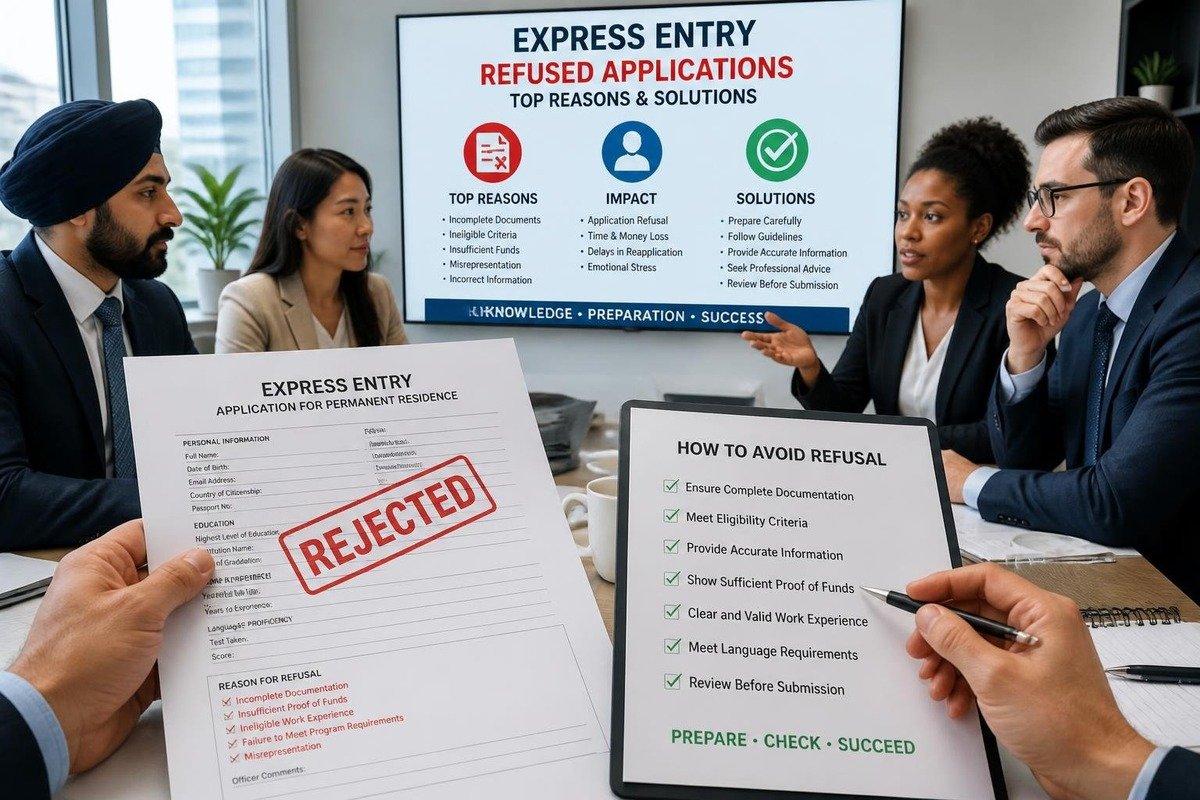
This is not a minor practical difference. The conjugal stream has a historically high refusal rate — estimated at 25 to 30 percent — compared to below 10 percent for spousal and common-law applications.
The primary driver of conjugal refusals is insufficient or unconvincing barrier evidence. The second most common issue is officers concluding that the couple had the ability to live together or marry but chose not to — reclassifying the barrier as a preference rather than a genuine obstacle.
Common-law refusals more often arise from insufficient cohabitation evidence — particularly when couples did not maintain the kind of documentary trail that IRCC expects, either because they didn’t know they needed it or because their shared life didn’t generate the typical paper evidence (cash payments for rent, utilities in one name only, one partner not officially changing their registered address).
Both categories can also face genuineness concerns if the relationship evidence is thin or the relationship appears to have escalated rapidly in proximity to an immigration application.
Can you switch categories mid-application?
Yes. If you apply as a conjugal partner and subsequently marry or establish cohabitation with your partner, you should notify IRCC immediately and file an updated marriage certificate or cohabitation evidence. IRCC can convert the application to the spousal or common-law category, which typically improves the application’s position and removes the conjugal barrier burden.
Similarly, if you begin an application as a common-law partner and marry during processing, notify IRCC and submit the marriage certificate. The application can be updated to reflect the new spousal status.
Which category applies to you: a decision framework
Work through these questions in order:
Are you legally married? If yes: spousal category. Stop here.
Have you lived together continuously for at least 12 months in a shared home? If yes: common-law category. Stop here.
Have you been in a committed relationship for at least one year, and were you specifically prevented from living together or marrying by a documented legal, immigration, or structural barrier you could not overcome? If yes: conjugal category may apply. If the reason you haven’t lived together is distance, preference, uncertainty, or lack of opportunity — not an identifiable, documented barrier — conjugal does not apply.
If none of the above apply: You are not currently eligible for any of the three sponsorship categories under Canadian family class immigration. Options may include working toward eligibility — establishing cohabitation, pursuing marriage, or waiting until the relationship meets the threshold — or exploring temporary pathways while eligibility develops.
Key takeaways
Common-law status requires 12 consecutive months of genuine cohabitation in a shared home. A long-term relationship without that period of shared residence, however deep and committed, does not qualify.
Conjugal partnership is a category of last resort for couples genuinely prevented from living together or marrying by documented barriers. It is not for couples who have not yet had the opportunity to live together.
Conjugal applicants must apply through the outland route only. Inland sponsorship is not available for conjugal partnerships, and no Spousal Open Work Permit is available until permanent residence is approved.
The conjugal refusal rate — historically 25 to 30 percent — is significantly higher than for spousal or common-law applications, driven primarily by insufficient or unconvincing barrier documentation.
Applying under the wrong category is a direct path to refusal. Confirming which category genuinely applies to your relationship before submitting is the single most important step in the process.
This post is for informational purposes only and does not constitute legal or immigration advice. IRCC definitions and requirements are subject to change — always verify current requirements at canada.ca. For complex cases — including those involving documented persecution risk, immigration inadmissibility, or ambiguous cohabitation history — consult a Regulated Canadian Immigration Consultant (RCIC) or immigration lawyer before applying.