How to Improve Your CLB Score for Express Entry CRS Points

If you’re sitting in the Express Entry pool watching draw after draw pass you by, your language score is the most likely culprit — and the most fixable one.
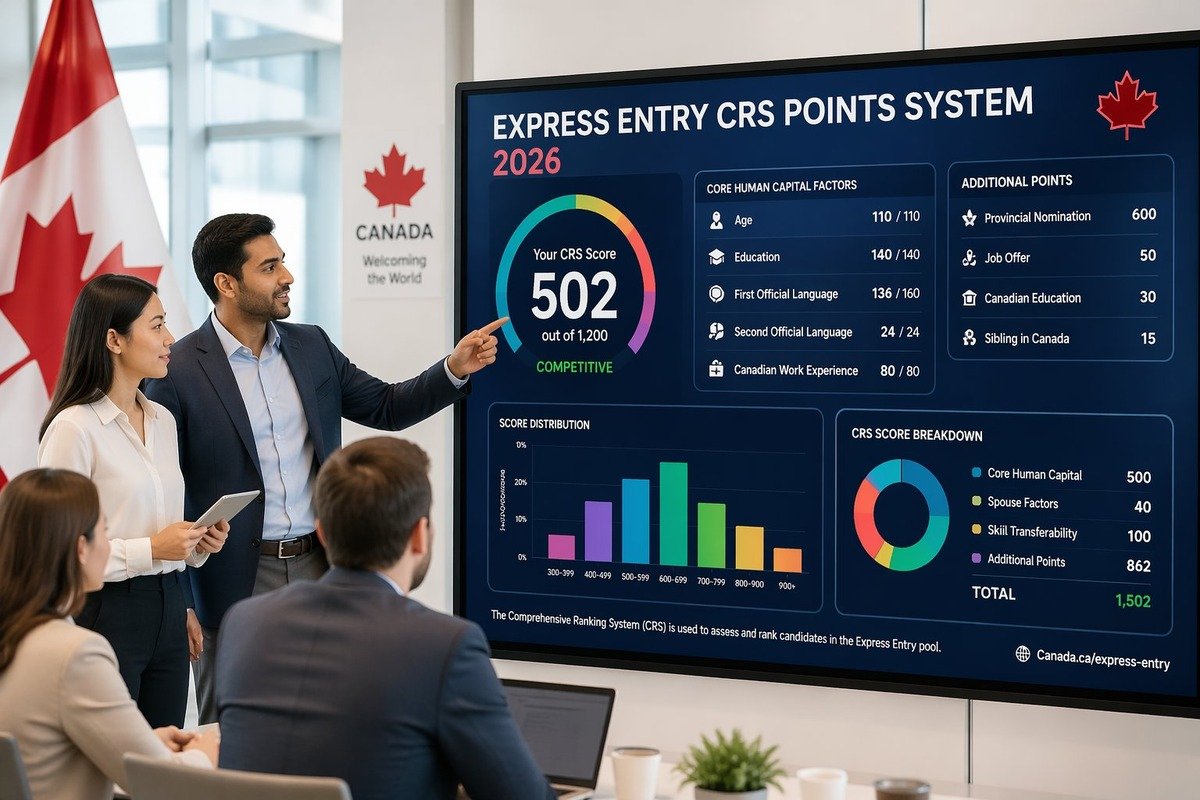
Language proficiency is the single largest controllable factor in your Comprehensive Ranking System (CRS) score. Since March 2025, job offer bonus points were removed from the CRS entirely, which means candidates can no longer rely on an employer-supported offer to make up for weak language scores. What remains is your human capital: your age, your education, your work experience, and your CLB level. Of those four, CLB is the only one where deliberate short-term effort consistently produces measurable point gains.
This guide explains exactly what a CLB improvement is worth in CRS points, which skills to fix first, and how to train for each section of the test in a way that actually moves the score.
Why language is the highest-return CRS factor
Before getting into preparation strategy, it helps to understand what the numbers actually mean.
For a single applicant, language points are worth up to 136 CRS points (34 per skill × 4 skills) for your first official language. But the real leverage is in the skill transferability section, which awards bonus points when your CLB level combines with your education or work experience.
Here is what that looks like in practice:
CLB 7 across all four skills (IELTS 6.0 each): 68 core language points. Education transferability (with a bachelor’s degree): up to 25 points. Work experience transferability (with 3+ years foreign experience): up to 25 points.
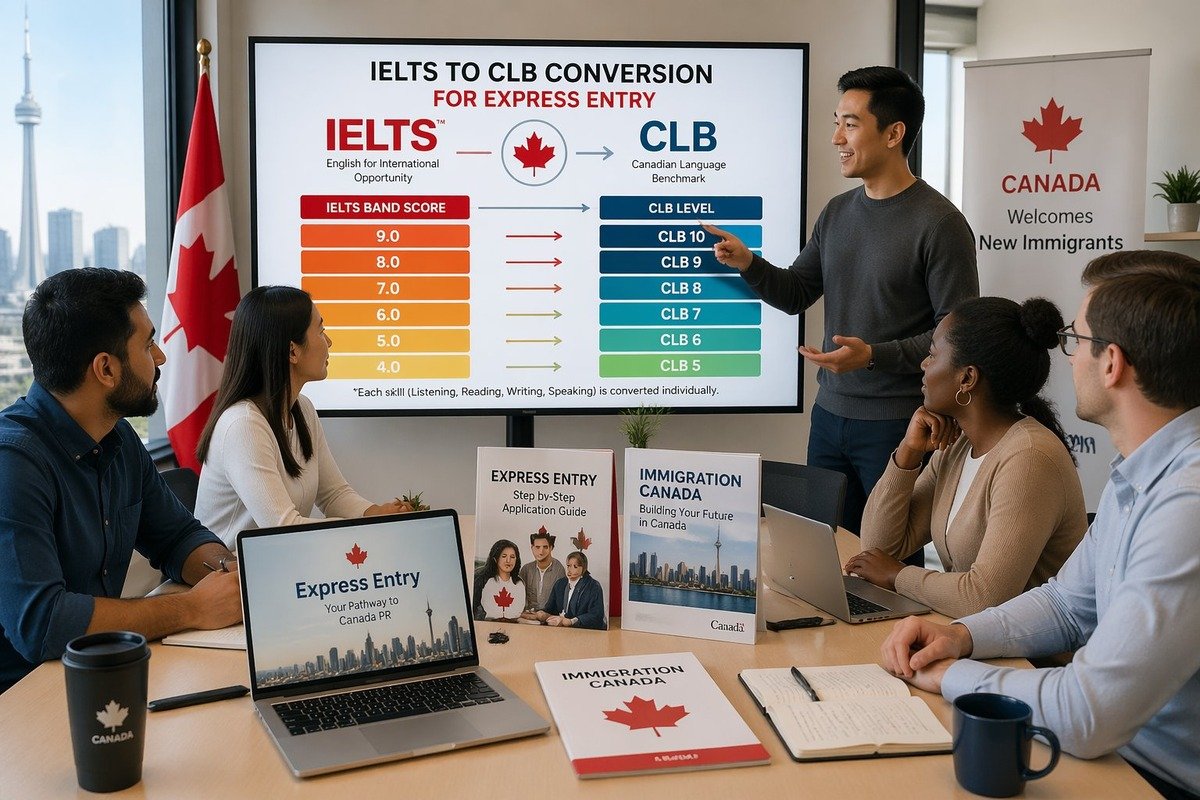
CLB 9 across all four skills (IELTS 8.0 Listening, 7.0 elsewhere): 124 core language points. Education transferability (same bachelor’s degree): up to 50 points. Work experience transferability (same 3+ years): up to 50 points.
The total swing from CLB 7 to CLB 9, for a candidate with a degree and solid work history, can reach 82 or more additional CRS points. For context, that is comparable to the difference between being invited in a competitive general draw and waiting many more months.
CLB 9 also works as a multiplier: it doubles the skill transferability maximums available to you. Without it, you leave up to 50 points on the table in transferability alone, regardless of how strong your education or experience credentials are.
One further data point worth knowing: adding French language proficiency at NCLC 7 or above — while also holding CLB 5 or higher in English — earns 50 additional CRS points for bilingualism, and opens access to category-based French-language draws with historically lower cut-off scores.
Before you prepare: diagnose your exact gap
The single most important step before any preparation is identifying which skill is holding you back. Your overall CLB equals your lowest individual skill — which means one underperforming section pulls your entire eligibility and CRS standing down.
Do not train evenly across all four skills. Most test-takers have a clear weak skill, and fixing that one skill from CLB 8 to CLB 9 often delivers more total CRS points than marginal gains across skills you’ve already mastered.
Take a full official practice test under timed conditions before anything else. Score yourself by skill. The gap between your best and worst sections tells you where to concentrate 60–70% of your preparation time.
The most common weak skills by profile type, based on patterns observed across test-takers:
Writing tends to be the most common bottleneck, particularly for test-takers who speak English fluently at work but have had less practice with formal structured writing.
Listening is the sneakiest gap, because reaching CLB 9 in Listening requires an IELTS band of 8.0 — significantly higher than the 7.0 required for the other three skills. Many candidates assume they’re training toward CLB 9 across all skills, but then discover their Listening result sits at CLB 7 because they only reached 6.0.
Speaking trips up candidates who have strong comprehension but limited practice speaking at length in English, particularly those who primarily use English for reading or writing in professional contexts.
Section-by-section improvement strategies
Listening: the skill that requires the most lead time
Because the CLB 9 threshold for Listening is IELTS 8.0 rather than 7.0, this is the section where the most preparation is usually required. Reaching 8.0 means getting fewer than five or six questions wrong across the entire 40-question test — a tight margin.
The IELTS Listening test uses a range of accents — British, Australian, North American, and others — across four sections of increasing complexity. Section 4, a solo academic monologue, is where candidates most often drop marks.
Effective preparation for Listening at the CLB 9 level involves:
Consistent daily exposure to spoken English in varied accents. Podcasts, radio programmes, and documentary audio from different English-speaking countries are more useful than you might expect — the goal is to reach the point where accent-switching mid-section doesn’t cost you attention.
Active listening rather than passive listening. When you practise with recordings, pause after each question set and identify which answers you missed and why — distraction, unfamiliar accent, complex syntax, or missed signal words. Passive listening builds familiarity; active review builds accuracy.
Note-taking technique. IELTS Listening questions are sequential, but the audio moves quickly. Practise writing key words and numbers while listening, without stopping to check spelling. In Sections 3 and 4, the questions are longer and more complex, so developing shorthand for quick capture is worth practising separately.
Aim to practise with official Cambridge IELTS practice tests rather than third-party materials, since the official tests most closely replicate the actual difficulty and pacing of the exam.
Reading: the fastest skill to improve
Reading is where most test-takers have the shortest gap to close, because improvement comes primarily from technique rather than underlying language ability. Most reading errors at the CLB 8–9 level come from time management and question-type errors, not from inability to understand the text.
IELTS General Training Reading includes three sections totalling 40 questions in 60 minutes. The most impactful technique changes:
Skim the passage first — read headings, topic sentences, and the final sentence of each paragraph to build a structural map before reading the questions. This saves you from re-reading sections you didn’t pay attention to on the first pass.
Do not answer in order if you get stuck. Spend no more than 90 seconds on a single question. Mark it, move on, and return if time allows. Time lost on one stubborn question costs you three solvable ones.
True/False/Not Given is where well-prepared candidates most commonly drop marks. “False” requires the passage to directly contradict the statement. “Not Given” means the passage neither confirms nor contradicts — the topic may not appear at all. Confusing these two is a consistent source of errors even at high proficiency levels.
Keyword matching: underline the key terms in each question before reading. Scan for synonyms and paraphrases in the passage, because IELTS rarely uses the same words verbatim.
A good target practice structure is three timed sections per session, strict 20-minute limit per section, followed by detailed review of every incorrect answer.
Writing: the most common bottleneck
Writing is where the gap between conversational fluency and test performance is widest. IELTS General Training Writing consists of two tasks in 60 minutes: Task 1 is a letter (20 minutes, 150 words minimum), and Task 2 is an essay (40 minutes, 250 words minimum). Task 2 carries twice the weighting of Task 1.
Common errors at the CLB 8–9 boundary:
Underdeveloped arguments in Task 2. Examiners look for a position clearly stated in the introduction, developed with specific reasoning in the body paragraphs, and reinforced in the conclusion. Listing points without developing them — adding “firstly, secondly, thirdly” without explanation — is the most common way to stay stuck at a lower band.
Repetitive vocabulary. The Writing score includes a vocabulary range criterion. Using the same core words repeatedly — particularly in the essay — signals limited range, even if the ideas themselves are sound. The fix is not memorising obscure words, but reading widely enough that you have natural access to paraphrases and collocations.
Grammar variety matters more than correctness alone. Mixing clause types — compound sentences, relative clauses, conditionals, passive constructions — demonstrates range. A response built entirely of simple sentences reads as restricted even if it contains no errors.
The most effective way to improve Writing is to write under timed conditions and get feedback from someone who knows the marking criteria. Practise at least two full Task 2 essays per week, aiming for 250–280 words completed within the 40-minute limit.
Speaking: the most practicable to improve daily
IELTS Speaking is a three-part interview with a human examiner, lasting 11–14 minutes. It is marked on four criteria: fluency and coherence, lexical resource (vocabulary), grammatical range and accuracy, and pronunciation.
The most impactful change for most candidates at the CLB 8–9 level is moving from answering questions in full stops to answering in extended turns. Examiners prompt brevity with follow-up questions only when responses are too short. The strongest responses in Parts 1 and 2 are those that develop naturally — a direct answer followed by a reason, followed by a specific example or elaboration.
Practical improvements:
Record yourself speaking for 2–3 minutes on a topic — anything — and listen back. You will notice habits invisible to you in the moment: filler words overused, repeated vocabulary, unclear consonants, sentences that stall or trail off. Self-review is more honest and more actionable than general advice.
Daily spoken English practice matters more than intensive weekend sessions. Even 15 minutes of structured speaking practice daily — discussing a news article, summarising a podcast you listened to, practising Part 2 monologue prompts — compounds over weeks in a way that cramming does not.
Do not memorise fixed answers. IELTS examiners are trained to detect rehearsed responses and will shift to unexpected follow-up questions to test whether you can actually adapt. The goal is to develop genuine spoken fluency in a range of topics, not to perform memorised scripts.
Pronunciation does not mean accent reduction. Examiners are not marking you on sounding British or North American. They are marking on clarity, consistency, and whether your pronunciation makes comprehension easier or harder. Specific consonants and vowels that cause confusion are worth addressing; general accent is not.
The retake decision: when to sit again and what to target
Once you’ve completed a preparation period, take another full practice test before booking your retake. Your practice scores should be consistently achieving your target CLB across all four skills before you sit the real exam — not occasionally hitting it on a good day.
There is no mandatory waiting period between IELTS attempts. If you receive your results and one skill is below your target, you can book a new date immediately. IRCC will use your most recent valid test result — provided it’s still within the two-year validity window.
The strategic consideration is timing. Your test results need to be valid both when your Express Entry profile is active and when you submit your actual Application for Permanent Residence. Applications can take six months or more to process, so ensure your results have enough validity remaining to cover the realistic processing timeline.
If you are within 15–20 CRS points of the recent cut-off scores, a single CLB level gain in one or two skills may be enough. If you are 40+ points below cut-off, plan for CLB 9 in all four skills as the minimum target before retesting.
One more lever: adding French proficiency
French language proficiency is the least obvious and most underutilised CLB-related CRS booster for English-dominant candidates.
Achieving NCLC 7 or above in all four French skills — while holding CLB 5 or above in English — earns 50 additional CRS points for bilingualism. It also qualifies you for French-language category draws, which have historically had cut-off scores far below those of general draws, sometimes in the 300–400 range.
French from zero to NCLC 7 typically requires serious commitment, but many Express Entry candidates already have partial French from school or professional exposure. A formal assessment of your current French level is worth doing before dismissing this option.
Key takeaways
Language proficiency, measured as CLB level, is the highest-return CRS factor under your direct control — especially since job offer points were removed in 2025.
CLB 9 across all four skills is the target that matters. It maximises core language points and doubles the skill transferability bonuses available from your education and work experience.
Diagnose your weakest skill before training. Fix the floor, not the ceiling — your overall CLB is determined by your lowest individual skill.
Listening requires a higher IELTS band (8.0) to reach CLB 9 than the other three skills (7.0). Build extra lead time for Listening preparation.
Writing is the most common bottleneck. Structured practice with feedback, not passive review, is what moves Writing scores.
Adding French at NCLC 7 earns 50 bonus CRS points and opens category-based draw eligibility with lower cut-offs.
This post is for informational purposes only and does not constitute legal or immigration advice. CRS criteria are subject to change — always verify current requirements at canada.ca. For tailored profile advice, consult a Regulated Canadian Immigration Consultant (RCIC) or immigration lawyer.