10 Reasons Express Entry Applications Get Refused — and How to Avoid Them
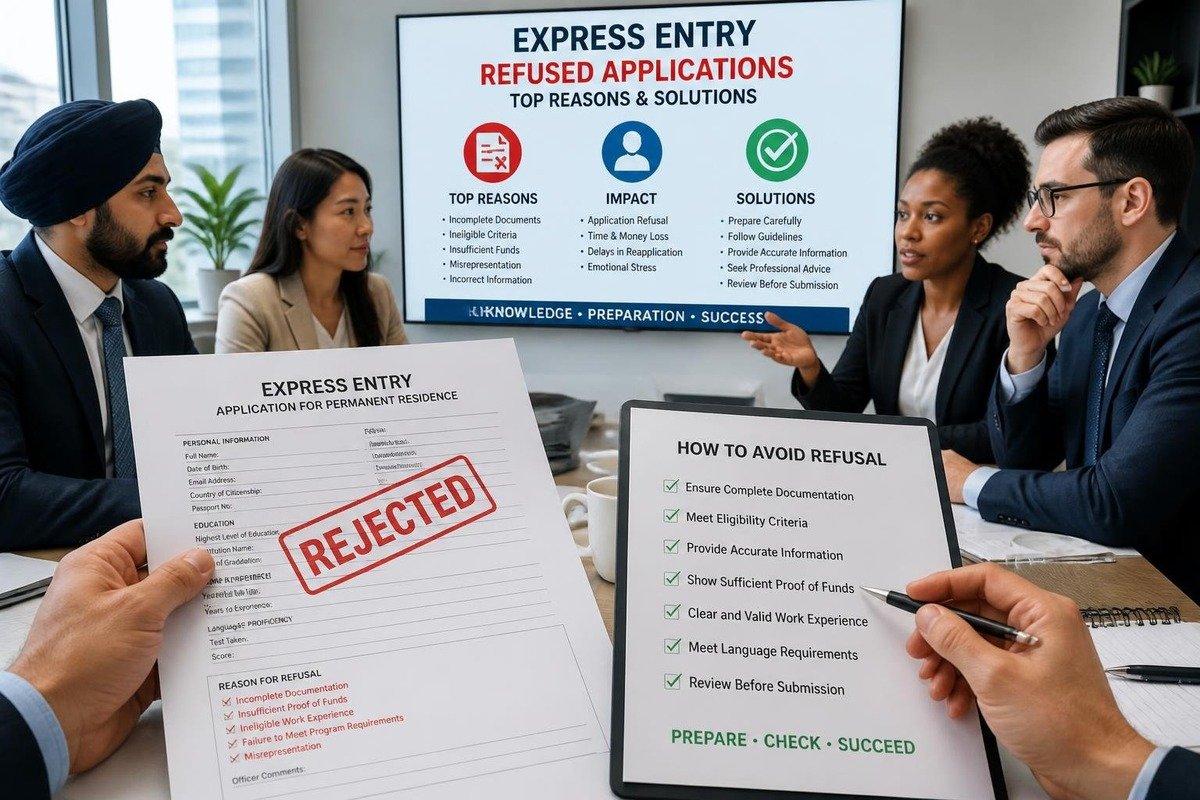
Receiving an Invitation to Apply is one of the most significant milestones in the Canadian immigration process. What many candidates don’t realise is that an ITA is not an approval — it is an opportunity to prove, with documents, everything you declared in your Express Entry profile. The application that follows is where refusals happen.
IRCC is explicit about this: incomplete or inconsistent applications are not sent back for correction. They are refused. An officer reviewing your file is looking for evidence that confirms what you claimed. If that evidence is missing, inconsistent, expired, or improperly formatted, the result is almost always a straight refusal rather than a request for more information. You then lose your ITA and return to the pool, or in serious cases face a multi-year bar from reapplying.
The good news is that the vast majority of Express Entry refusals are preventable. They stem from a predictable set of mistakes that appear again and again across applications. This guide covers each of them in full detail.
1. Work experience letters that are incomplete or don’t match the NOC
This is the single most common reason applications fail after an ITA. IRCC requires a specific set of information in every employment reference letter, and officers cross-reference those letters against the NOC description you claimed in your profile.
A compliant employment reference letter must be on official company letterhead and include every one of the following elements:
- Your full name
- The company’s name, address, phone number, and email
- Your job title and whether the position was full-time or part-time
- Your exact start and end dates (or confirmation of ongoing employment)
- Your hours worked per week
- Your annual salary or hourly rate and benefits
- A description of your main duties and responsibilities
- The name, title, and signature of your direct supervisor or HR representative
The duties section is where most letters fall short. Officers compare what is written against the lead statement and main duties listed in the NOC description for the code you claimed. At least a substantial portion — typically 60 to 80 percent — of the main duties in the NOC description must align with your documented experience. Generic phrases like “handled various tasks” or “supported the team” are not sufficient. The letter needs to reflect specific, verifiable responsibilities that map directly to the NOC.
A software developer letter stating only “performed software tasks” without detailing coding, system design, testing, or deployment — or a retail supervisor letter omitting supervision of staff, inventory control, or scheduling — are common examples of documentation that gets excluded.
How to avoid it: Get your reference letter before your ITA arrives if possible — tracking down former employers under a 60-day deadline is stressful and sometimes impossible. For each role, pull up the actual NOC description and compare it to your letter line by line. If your letter doesn’t mention duties that appear in the NOC’s main duties list, request a revised version. If you are self-employed, you will need business registration documents, invoices, bank statements showing business income, client contracts, and a statutory declaration or accountant’s letter confirming your role and duties.
2. Wrong NOC code — or a code that doesn’t reflect actual duties
Your NOC code is the backbone of your eligibility claim. Choosing an incorrect NOC is a leading cause of refusals, because it can invalidate your entire work experience claim. IRCC assesses based on actual duties performed — not your job title.
Two specific errors cause most NOC-related refusals:
Choosing based on title, not duties. Someone with the title “Manager” who doesn’t have actual supervisory or decision-making responsibilities may be claiming a TEER 0 or 1 code when the actual role sits in TEER 2 or 3 — or even TEER 4, which disqualifies the experience entirely.
Misclassifying TEER 4 or 5 roles as skilled. If your actual job duties place the role in TEER 4 or TEER 5, no reference letter — however well-written — can save the application. The experience simply doesn’t qualify, regardless of duration or compensation.
Consistency matters across all documents: your reference letters, resume, and other evidence must fully support the claimed NOC. Claiming multiple roles under a single mismatched NOC is a common error that raises credibility concerns.
How to avoid it: Go to the IRCC NOC finder and look up occupations by searching for your actual daily duties, not your job title. Read the lead statement and the full list of main duties. Choose the code where your day-to-day work matches the most duties, not just the one with the most impressive title. If you genuinely performed duties across two NOC codes, document both separately.
3. Expired documents — language tests, ECAs, and police certificates
Every key document in an Express Entry application has a validity window, and submitting an expired document is treated the same as not submitting it at all.
Language test results — IELTS, CELPIP, TEF Canada, and TCF Canada results are valid for two years from the test date. Submitting an expired certificate — or the wrong report type — often results in refusal. Because Express Entry processing can take six months or more after you submit your PR application, test results that are valid when you receive your ITA may expire during processing if you sat the test long before applying.
Educational Credential Assessments — ECAs from most designated bodies are valid for five years. Submitting an ECA past its validity window, or submitting an ECA from a body that isn’t designated for the program you’re applying under, causes the education claim to be disregarded.
Police certificates — for any country other than your current country of residence, the police certificate must be issued after the last date you stayed in that country for six or more months continuously. For the country where you currently live, the certificate should be issued no more than six months before you submit your PR application. Submitting a certificate that predates your most recent stay in a country is a completeness failure.
All Express Entry applicants need at least one police certificate. Police certificates are required for all family members, spouses, and children aged 18 or older. Country-specific requirements also vary: Australia requires traffic history for Queensland residents and a Full Licence History Search for Victoria residents. New Zealand requires a Consent to Disclosure of Information Form rather than a police certificate, which IRCC requests on your behalf.
How to avoid it: Create a document validity tracker the moment you receive your ITA. List every document, its issue date, and its expiry date. Prioritise obtaining police certificates and renewing language tests if they are within six months of expiry. Do not assume a document that was valid when you entered the pool is still valid when you submit.
4. Profile and application inconsistencies — the misrepresentation trap
When you receive an ITA, IRCC expects the information in your PR application to match exactly what you declared in your profile — otherwise it may be rejected. Even minor inconsistencies across your profile and application can trigger concerns for officers, whether intentional or not.
This happens more often than candidates expect. Common sources of inconsistency include:
- A job that ended between ITA and application submission that wasn’t updated in the profile
- A change in marital status — marriage, separation, or the birth of a child — that wasn’t reflected
- Salary or job title details in a reference letter that differ from what was entered in the profile
- Dates of employment that are slightly off between the profile and the reference letter
Misrepresentation refers to providing false, misleading, or incomplete information. If there is a difference between your application and government records, IRCC can refuse your application, and you may not be able to reapply for up to five years. The five-year bar applies even to inadvertent inconsistencies that an officer interprets as wilful misrepresentation.
You can freely update your Express Entry profile at any time before receiving an ITA without being penalised, and doing so will not change the date and time of creation used for tie-breaking purposes. IRCC explicitly states that you must update your profile if your situation changes.
How to avoid it: Before submitting your PR application, go through your Express Entry profile entry by entry and compare each claim against the supporting document you’re including. Dates, job titles, hours worked, and salary figures all need to match precisely. If your circumstances changed between your ITA and submission, update your profile before submitting the application.
5. Claiming ineligible work experience
It is easy to unintentionally claim work experience that isn’t actually eligible under Express Entry, and doing so leads to refusal.
The most common errors:
Counting study-period work incorrectly. Under CEC, work experience gained while you were a full-time student does not count — even if the work was paid and on a co-op term — unless you meet specific exemption criteria. Under FSWP, it may count if it was continuous, paid, and met all other program requirements. Under FSTP, it never counts.
Miscalculating hours. IRCC defines full-time work as 30 hours per week — 1,560 hours per year. If you work more than 30 hours per week, you cannot count the excess hours. Part-time hours across multiple jobs can be combined, but each job’s hours must be documented separately and the total must reach 1,560.
Counting unpaid experience. Volunteer positions, unpaid internships, and commission-only roles where no commission was earned do not count regardless of duties performed.
Claiming experience not yet accumulated. This becomes a problem when a candidate receives an ITA and submits an application, and IRCC discovers the claimed experience had not yet been achieved at the time of profile creation.
How to avoid it: Before entering your work experience in the profile, calculate your hours with a calendar — count actual weeks worked, multiply by hours per week, and verify the total reaches 1,560. For CEC applicants, confirm the work was completed while you held valid temporary resident status and were not a full-time student.
6. Settlement funds that don’t meet requirements
Settlement funds are a frequent source of refusal. Applicants must demonstrate they meet minimum financial thresholds and maintain funds throughout processing. Bank accounts must belong to the applicant or joint spouse and be fully accessible. Borrowed funds, private loans, or conditional assets are not accepted.
Specific documentation failures that cause refusals:
Submitting internet copies of bank statements that are not printed on bank letterhead. Screenshots from online banking portals are not accepted. You need either printed statements with the bank’s letterhead or an official bank letter on letterhead with account details.
Funds that drop below the threshold between application submission and the time of officer review. IRCC may check that your balance meets requirements at multiple points in the process, not just when you first submitted.
Using outdated fund tables. The minimum settlement fund amounts are updated annually, typically each July. Using outdated figures can cause rejection.
How to avoid it: Obtain official bank letters — not printed account summaries — issued within 30 days of your application submission. If you are using multiple accounts, include documentation for each. Confirm you are using the current IRCC threshold table for your family size, not the figures from a prior year.
7. Missing or incorrectly formatted police certificates
Police certificates are among the most complex documents to gather correctly because every country has different procedures, different certificate types, and different IRCC requirements.
IRCC has specific requirements for the correct police certificate for each country. Some countries issue different types of certificates, and sometimes IRCC requires two types. Reading the instructions for your specific country carefully is essential.
Common specific failures include: submitting a UK police certificate that shows “no live traces” rather than “no traces” — the former indicates ACRO holds additional information that needs to be disclosed separately. Not submitting the Australian traffic history when required for Queensland or Victoria residents. Forgetting to include police certificates for accompanying family members aged 18 or older.
How to avoid it: Look up your country’s specific police certificate requirements on the IRCC country-specific instructions page before ordering. Check whether your country requires one or two certificates. Order as early as possible — some countries take six to eight weeks to issue police certificates, which can consume a significant portion of your 60-day submission window.
8. Translation errors — missing originals or improper affidavits
IRCC requires three things for any document not in English or French: a copy of the original document, the full translation in English or French, and the translator’s affidavit or certification attesting to the translator’s language proficiency and the accuracy of the translation.
A common and easily avoidable mistake is submitting only the translation without including the original-language source document. IRCC will not accept the translation alone.
How to avoid it: For every non-English, non-French document in your application — birth certificates, marriage certificates, police certificates, employment records, academic transcripts — prepare a package containing all three components. Use a certified translator who can provide a proper affidavit. Do not ask friends or family to translate documents.
9. Missing the 60-day deadline or failing to respond to IRCC requests
The 90-day deadline is absolute — IRCC does not provide extensions except in exceptional circumstances, and incomplete applications are automatically refused. You lose your ITA and need to re-enter the pool. (Note: the post-ITA submission window is 60 days for most programs.)
After submission, IRCC may issue procedural fairness letters, requests for additional documents, or biometrics appointments. Failing to respond to any of these requests within the specified timeframe results in the application being withdrawn.
How to avoid it: Begin gathering documents the moment you enter the Express Entry pool — do not wait for your ITA. Create a full document checklist on day one of your ITA window, assign a deadline to each item, and check your IRCC secure account daily. Book biometrics immediately if requested — availability can be limited.
10. Incomplete passport uploads and missing family member documents
You need to upload the biographical page of your passport and any pages with stamps, markings, entry or exit stamps, or visas. Uploading only the biographical page while omitting stamped pages is a completeness failure.
For applications including dependants, IRCC requires supporting documents for every included family member — regardless of whether they are coming to Canada. Marriage certificates, birth certificates, adoption orders, custody agreements, and passports must all be included and must be current.
How to avoid it: Scan your entire passport, not just the biographical page. For family members, prepare a separate document folder for each person before you receive your ITA. Ensure birth certificates and marriage certificates have been officially translated if they are not in English or French.
The refusal nobody expects: the ECA that wasn’t uploaded
The ECA, as well as copies of your degrees and academic transcripts, must be uploaded even if IRCC does not explicitly ask for them on the upload page. Many candidates assume that because the system didn’t prompt them to upload a document, it isn’t required. IRCC’s upload interface does not always surface every required document — the responsibility for completeness is entirely yours.
One rule that governs everything
Every refusal in this list comes back to the same principle: IRCC does not fix your application for you. An incomplete document is not returned. An inconsistency is not flagged for clarification. An expired test result is not treated as a minor administrative issue. When an officer finds a problem, the standard response is refusal — sometimes with serious consequences for future applications.
The only effective protection is preparation before submission: gathering every document, verifying every date, and checking every detail against the official requirements before you hit submit.
This post is for informational purposes only and does not constitute legal or immigration advice. IRCC requirements are subject to change — always verify current requirements at canada.ca. If your application has been refused, consult a Regulated Canadian Immigration Consultant (RCIC) or immigration lawyer before reapplying.