WES vs IQAS vs Other ECA Bodies: Which Should You Choose for Canadian Immigration?
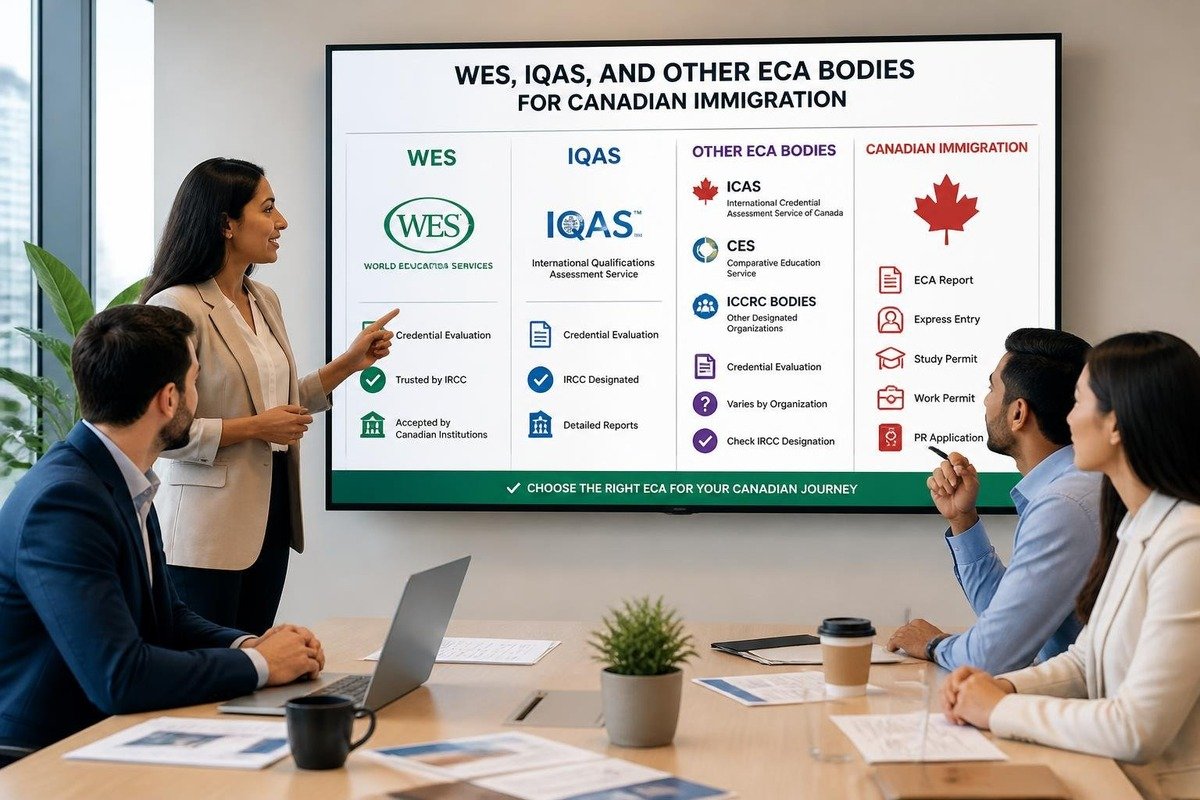
All five general ECA bodies designated by IRCC are equally valid in IRCC’s eyes. An ECA from IQAS and an ECA from WES carry exactly the same weight with immigration officers — both are accepted for Express Entry, both are valid for five years, and both fulfill the mandatory requirement for the Federal Skilled Worker Program.
So the question is not which body IRCC prefers. The question is which body is most likely to get you the result you need, in the time you have, at a cost that makes sense, without running into document submission problems along the way.
Those four factors — equivalency outcome, processing time, fee structure, and document submission flexibility — differ meaningfully across the five bodies. And for certain credential types and countries of origin, the choice of body can change your CRS education points entirely.
The five bodies at a glance
Before the detailed comparison, here is a quick orientation:
WES (World Education Services) — the most widely used ECA body globally, processing the largest volume of Canadian immigration assessments. A non-profit organisation. Fast processing, strict document requirements, strict assessment standards.
IQAS (International Qualifications Assessment Service) — operated by the Government of Alberta. More flexible document submission rules, more generous assessment standards for certain credential types, slower than WES.
ICES (International Educational Credential Evaluation Service) — operated by the BC Institute of Technology. A balanced middle-ground option, particularly well-suited for Asia-Pacific applicants and those whose credentials ICES recognises from its institutional database.
CES (Comparative Education Service) — operated by the University of Toronto School of Continuing Studies. Known for more generous equivalency outcomes on certain master’s-level credentials, particularly postgraduate diplomas from specific countries. Per-credential fee structure.
ICAS (International Credential Assessment Service of Canada) — a private assessment service. Generally the slowest of the five, but sometimes the most thorough for complex or unusual credentials.
The factor that matters most: equivalency outcome
This is where the choice of body has real consequences for your CRS score.
All five bodies assess the same credentials — but they sometimes reach different equivalency conclusions. The difference between a “Master’s degree” and a “one-year postgraduate diploma” equivalency is 15 CRS points in the core education section alone, and up to 25 additional CRS points in skill transferability. A 40-point gap from a single ECA decision can be the difference between receiving an ITA and staying in the pool.
Two specific patterns appear consistently in applicant communities and are worth understanding:
Indian MBAs and WES. WES applies strict equivalency standards to Indian MBA programmes. Unless the MBA was awarded by an IIT or IIM, WES typically assesses it as a one-year postgraduate diploma — not a master’s degree. This is one of the most well-documented equivalency gaps in the Canadian immigration community. IQAS, ICES, and CES generally assess Indian MBAs as master’s degrees regardless of institution. If you hold an Indian MBA from a non-IIT/IIM institution, WES is almost certainly the wrong choice — the CRS point difference is substantial.
Post-Soviet “Specialist” diplomas. A five-year specialist diploma awarded in Russia, Ukraine, or other post-Soviet countries is often treated differently across bodies. WES typically recognises five-year specialist diplomas as master’s equivalents for programmes over three years. IQAS and ICES tend to reach similar conclusions. However, the exact treatment varies by programme and country, and bodies differ on whether a four-year or five-year specialist programme clears the master’s threshold.
M.Sc, M.Com, M.A degrees from certain countries. WES sometimes assesses these as postgraduate diplomas or bachelor’s equivalents rather than master’s degrees, particularly for programmes under two years. IQAS, ICES, and CES more consistently award master’s equivalency for these credentials.
Distance learning and open university programmes. WES does not accept many distance-learning credentials or degrees from open universities in certain countries. IQAS is significantly more flexible here, often successfully assessing credentials that WES has rejected.
The practical implication: if your credential is a straightforward bachelor’s or master’s from a widely recognised institution, the equivalency outcome is unlikely to differ significantly between bodies. If your credential is an MBA, a specialist diploma, an M.Sc/M.Com/M.A, or from a distance-learning institution, choosing the wrong body could cost you 15 to 40 CRS points.
Processing time: WES is fastest, ICAS is slowest
If timeline is your primary constraint — you have a language test that will expire, an Express Entry ITA deadline approaching, or you simply want to enter the pool quickly — this is the most important factor.
WES: Approximately 20 to 35 business days from the date all documents are received. WES consistently processes the fastest among the five general bodies. Many immigration consultants cite WES as the default recommendation on processing speed alone.
IQAS: Approximately 15 to 25 business days from when the application reaches “in line for processing” status, with rush service available. IQAS has significantly improved its processing times in recent years and now competes closely with WES on speed. The rush service option is valuable for applicants with tight timelines.
CES: Approximately 10 to 15 weeks for standard processing — considerably slower than WES or IQAS.
ICES: Approximately 8 to 12 weeks for standard processing.
ICAS: The slowest of the five, with processing times of 20 weeks or more in some cases.
One important timing consideration: processing time at the ECA body is only part of your total wait. The larger delay is typically the institutional transcript request — getting your university to send official transcripts takes two to eight weeks depending on the institution. This wait applies regardless of which body you choose and begins before your ECA application clock even starts.
Peak season — September through December — consistently extends processing times across all five bodies due to higher application volumes.
Document submission: where WES is strictest
This is a genuinely practical difference that affects how difficult the application process is.
WES and ICES require transcripts to be sent directly from your institution to the ECA body — either electronically through a secure portal or as a sealed, stamped official envelope. You cannot collect your own transcripts and forward them. Once a transcript envelope is opened, it is considered invalid. This requirement is strictly enforced and is the most common reason WES applications get held up.
IQAS and CES are more flexible. You can collect transcripts yourself in a sealed, stamped envelope and submit them to IQAS or CES directly. IQAS also accepts digital transcripts through third-party verification services like Digitary, Truecopy, and WorldwideTranscripts. This flexibility significantly reduces the coordination burden, particularly for applicants from countries where institutions are slow to send documents or do not have established electronic partnerships.
Multiple credential fee structure. WES and IQAS both charge a single flat fee regardless of how many credentials you are submitting — you pay once whether you are assessing one degree or three. CES and ICES charge per credential. If you are assessing two or more credentials to claim dual-credential CRS points (worth 128 points versus 120 for a single credential), WES and IQAS are considerably cheaper for multi-credential assessments.
Fee comparison
| Body | Standard fee (CAD) | Per-credential or flat? | Rush option? |
|---|---|---|---|
| WES | ~$226–$256 + delivery | Flat for multiple credentials | No standard rush |
| IQAS | ~$200 + delivery | Flat for multiple credentials | Yes |
| ICES | ~$200 + delivery | Per credential | No |
| CES | ~$210 per credential + delivery | Per credential | No |
| ICAS | ~$220 + delivery | Varies | No |
These figures are approximate — fees are updated periodically and vary slightly based on country of submission and additional services (certified copies, courier options). Verify current fees on each body’s official website before submitting.
All ECA fees are non-refundable once the application has been submitted, regardless of outcome.
Geographic recognition and institutional familiarity
No body publishes a list of institutions it recognises or rejects. But applicant experience over time has established some patterns worth knowing:
WES has the broadest institutional database and established electronic partnerships with institutions in India, the Philippines, Nigeria, the UK, and most Western countries. For applicants from these countries with degrees from mainstream universities, WES’s familiarity with the institution speeds the verification step. WES is also accepted by most US universities and licensing bodies, making it the most portable report if you may eventually need the assessment outside Canada.
IQAS is particularly well-regarded for credentials from the Middle East, Eastern Europe, and parts of Africa where WES has had fewer institutional partnerships or where transcript verification processes are less standardised. IQAS’s more detailed assessment approach and greater flexibility make it a strong fallback for any applicant who has been rejected or is uncertain about WES.
ICES has established particular recognition among applicants from Asia-Pacific — China, Japan, South Korea, Australia — and is accepted by the College of Nurses of Ontario, making it a practical choice for nursing professionals who need both an immigration ECA and recognition for licensure purposes.
CES has particular depth with European credentials, including from France and francophone systems generally, and is often recommended for applicants with complex multi-institutional educational histories due to its thorough in-depth assessment approach.
ICAS is used more rarely due to its slower processing times, but is sometimes recommended for credentials that other bodies have found difficult to assess.
PNP acceptance: portability beyond Express Entry
Your ECA must be accepted not just by IRCC federally but by any Provincial Nominee Program you apply to. Most PNPs accept all five designated bodies, but the Ontario Immigrant Nominee Program (OINP) has historically shown a strong preference for WES. If Ontario is your target province and you intend to use the OINP, WES is the safer choice for portability.
All five bodies are accepted for the federal Express Entry programs. For provincial-specific programs outside Ontario, verify the ECA acceptance requirements on the province’s immigration website before committing to a body.
Can you use the same ECA for multiple applications?
Yes. As long as your ECA is within its five-year validity window, you can use it across multiple Express Entry profiles, multiple PNP applications, and for employment purposes. You do not need a new ECA for each application. Keep your ECA reference number and report saved — you will need both whenever you create a new profile or application.
If your ECA expires, most bodies offer a renewal process that is faster and cheaper than a first-time application, since the institution verification step may not need to be repeated from scratch.
The decision framework: which body for your situation
You have a straightforward bachelor’s or master’s from a widely recognised institution in India, Nigeria, Philippines, or a major Western country, and you want the fastest result: WES.
You hold an Indian MBA from a non-IIT/IIM institution: Do not use WES. Use IQAS, ICES, or CES. WES will very likely assess your credential as a one-year postgraduate diploma rather than a master’s degree — a difference of up to 40 CRS points.
You hold an M.Sc, M.Com, or M.A from a South Asian or African institution that is under two years: Consider IQAS or ICES over WES. These bodies more consistently award master’s equivalency for these credential types.
You completed a distance-learning or open university degree: IQAS is the most accommodating. WES rejects many distance-learning credentials outright.
You are applying from a country where your institution cannot easily send transcripts directly to the ECA body: IQAS or CES, both of which accept applicant-handled sealed transcripts.
You are assessing two or more credentials and cost is a factor: WES or IQAS — both charge a flat fee for multiple credentials, unlike CES and ICES which charge per credential.
You plan to settle in Ontario and may use the OINP: WES, for portability.
You have already been rejected by WES or have reason to believe WES may not recognise your institution: IQAS is the strongest fallback. Its more flexible approach and government backing make it the go-to second choice.
You are uncertain which body will give the best result for your specific credential: It is permitted to apply to two different bodies and use whichever report is more favourable. This adds cost and time, but for credentials with genuine uncertainty — particularly postgraduate diplomas, non-standard master’s degrees, or credentials from institutions with limited international recognition — the CRS point gain can far outweigh the extra assessment fee.
Key takeaways
All five bodies are equally accepted by IRCC. The differences are in equivalency outcomes, processing speed, document submission flexibility, fee structure, and PNP portability.
Equivalency outcome is the most consequential factor. For certain credential types — Indian MBAs, M.Sc/M.Com/M.A from South Asian countries, distance-learning degrees, post-Soviet specialist diplomas — WES is more likely to return a lower equivalency than IQAS, ICES, or CES. The CRS point difference can reach 40 points.
WES is fastest and most portable. If your credential is straightforward and your institution is widely recognised by WES, it remains the default choice for applicants who prioritise speed and future portability.
IQAS is the strongest alternative. It is more flexible on documents, more lenient on non-traditional credentials, offers rush processing, charges a flat fee for multiple credentials, and is backed by the Alberta government.
WES and IQAS both charge flat fees for multiple credentials. CES and ICES charge per credential — making them more expensive if you are assessing two or more degrees.
You can apply to two bodies and use the more favourable result. For uncertain cases, this is a legitimate strategy.
This post is for informational purposes only and does not constitute legal or immigration advice. ECA fees, processing times, and equivalency practices are subject to change — always verify current information at each body’s official website and at canada.ca before applying.