Federal Skilled Worker vs Canadian Experience Class: Which Express Entry Stream Fits You?

Canada’s Express Entry system manages three federal immigration programs, but two of them dominate the conversation: the Federal Skilled Worker Program (FSWP) and the Canadian Experience Class (CEC). Between them, they account for the vast majority of Express Entry invitations issued every year.
Both programs use the same Comprehensive Ranking System, the same pool, and the same draw process. But they are designed for fundamentally different candidates — and choosing the wrong one, or failing to recognise that you qualify for both, can cost you months in the pool.
This post explains exactly who qualifies for each program, how the eligibility requirements differ, what each stream means for your CRS score and draw access, and how to decide which one to focus on.
The core distinction: where your work experience is from
The single most important difference between FSWP and CEC is where your qualifying work experience was obtained.
Federal Skilled Worker Program is designed for skilled workers whose experience was gained outside Canada — or a combination of inside and outside. The key requirement is at least one year of skilled work experience within the past ten years, in any country.
Canadian Experience Class is designed for people who have already worked in Canada on a valid work permit. It requires at least one year of skilled Canadian work experience within the past three years.
This distinction shapes every other difference between the programs: who can apply, what documents are needed, what advantages each stream confers in the draw environment, and which long-term immigration strategy makes the most sense.
Federal Skilled Worker Program — who qualifies and how it works
FSWP is for skilled professionals who have built careers, often internationally, and want to bring those qualifications to Canada. It is the classic pathway for applicants who are currently living and working outside Canada.
Minimum requirements
To be eligible for FSWP, you must meet all of the following:
Work experience: At least one continuous year of full-time paid skilled work (1,560 hours) within the past ten years. The experience can be in Canada or abroad. It must fall within TEER categories 0, 1, 2, or 3 under the National Occupational Classification (NOC). Volunteer work and unpaid internships do not count. Part-time work is acceptable as long as the hours add up to 1,560. Work during studies can count if it was paid and continuous.
Language: A minimum of CLB 7 in all four skills — Listening, Reading, Writing, and Speaking — in either English or French, verified through an approved language test.
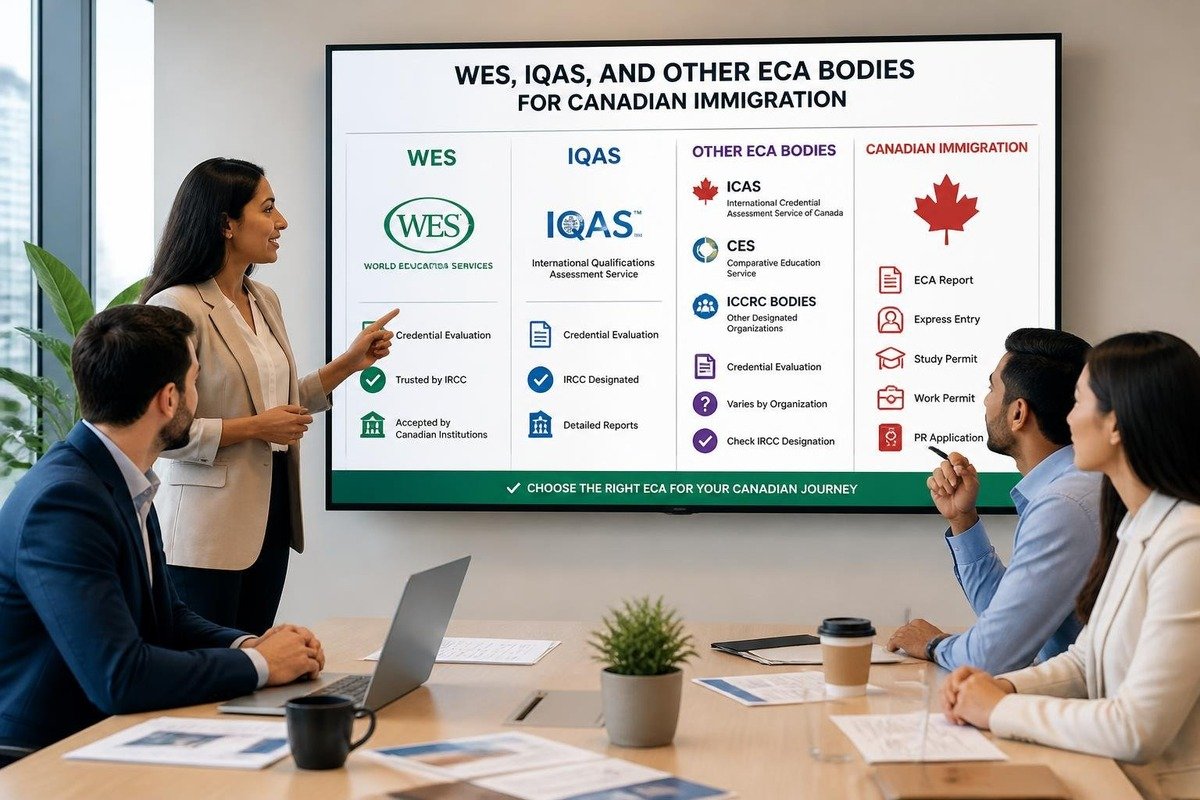
Education: A Canadian secondary or post-secondary credential, or a foreign credential supported by an Educational Credential Assessment (ECA) from a designated organisation. There is no minimum level specified — even a high school diploma technically meets the education bar — but higher education significantly increases CRS points.
The 67-point selection grid: This is unique to FSWP and does not exist for CEC. Before you enter the Express Entry pool under FSWP, IRCC assesses you against a separate 100-point selection grid covering language (maximum 28 points), education (maximum 25 points), work experience (maximum 15 points), age (maximum 12 points), a job offer (maximum 10 points), and adaptability (maximum 10 points). You must score at least 67 out of 100 to qualify. These points are entirely separate from your CRS score — they are a gate you must pass to enter the pool, not a ranking within it.
Proof of funds: FSWP applicants must demonstrate they have sufficient settlement funds to support themselves and their family in Canada, unless they hold a valid Canadian job offer. CEC applicants do not have this requirement.
Admissibility: You must be admissible to Canada — no criminal inadmissibility or medical conditions that would cause excessive demand on services.
Residence: You must plan to live outside Quebec, which runs its own selection system.
What FSWP looks like in practice
FSWP is the pathway for a software engineer in Germany with five years of experience who has never worked in Canada. It is the route for an accountant in Nigeria with a post-secondary credential and CLB 7 English who is preparing their ECA. It is the option for an engineer in India who scored 72 on the selection grid and wants to enter the pool while still employed abroad.
The critical planning document is the selection grid. Before building an Express Entry strategy around FSWP, calculate your selection factor score carefully. If you score exactly 67, you clear the gate but leave no margin for error. Improving language scores is the fastest way to increase your selection factor score if you’re near the threshold.
Canadian Experience Class — who qualifies and how it works
CEC was created specifically for temporary residents who have built their lives in Canada and want to make the transition to permanent status. It is the natural progression for international graduates, temporary foreign workers, and professionals on work permits.
Minimum requirements
Canadian work experience: At least one year of full-time skilled work (1,560 hours) in Canada within the past three years, in a TEER 0, 1, 2, or 3 occupation. The experience must have been gained while you were authorised to work under temporary resident status. Remote work counts only if you were physically in Canada for a Canadian employer at the time. Volunteer work and unpaid internships do not count.
Language: CLB 7 in all four skills for TEER 0 or 1 occupations. CLB 5 in all four skills for TEER 2 or 3 occupations.
No education requirement: CEC does not require you to have a specific level of education. You do not need an ECA.
No proof of funds: Unlike FSWP, CEC applicants are not required to show settlement funds. The rationale is that you are already established in Canada and supporting yourself.
No selection grid: There is no 67-point threshold to clear. If you have the qualifying work experience and language scores, you are eligible.
Residence: Same as FSWP — you must plan to live outside Quebec, though work experience gained in Quebec can count toward the requirement if you show you don’t intend to settle there.
What CEC looks like in practice
CEC is the pathway for an international student who graduated from a Canadian university, completed a Post-Graduation Work Permit, and has been working as a software developer for 14 months. It is the route for a temporary foreign worker in Ontario who has been in the country for two years on a company-specific work permit. It is the option for a nurse on an open work permit who has accumulated one year of TEER 1 experience in a Canadian hospital.
One practical nuance: although CEC does not require an education credential, submitting your education details — including an ECA for a foreign degree — adds CRS points for education even if the program doesn’t mandate it. Many CEC-eligible candidates leave education points on the table by not including this information in their profile.
The draw environment: what each stream means for your chances
On paper, FSWP and CEC use the same CRS. In practice, they operate in very different draw landscapes — and understanding this difference is more strategically important than most candidates realise.
CEC in the 2025 draw environment
CEC was the most actively drawn Express Entry stream throughout 2025. IRCC held regular CEC-specific draws, issuing thousands of invitations per round. Cut-off scores for CEC draws ranged from 515 to 547 during 2025 — competitive but consistent, and with enough draw frequency that candidates with strong profiles moved through the pool relatively predictably.
The reason CEC draws are held separately from general draws is deliberate policy: IRCC has consistently emphasised that candidates with Canadian experience are more likely to integrate successfully and contribute immediately to the labour market. The research supports this — CEC immigrants tend to find employment faster and at higher wage levels than candidates who arrive without prior Canadian experience.
FSWP in the 2025 draw environment
FSWP candidates faced a markedly more difficult 2025. No general draws — the main vehicle through which FSWP-only candidates receive invitations — were held at all in 2025. The last general draw occurred in April 2024. FSWP-only candidates who did not qualify for any category-based draw (healthcare, French-language, STEM, education) had effectively no pathway to an invitation throughout 2025.
This is the sharpest practical difference between the two streams right now: CEC candidates have access to regular, predictable program-specific draws. FSWP-only candidates are dependent on either qualifying for a category-based draw or waiting for general draws to resume.
The strategic implication for FSWP applicants is significant: if you can gain Canadian work experience — through a work permit, a working holiday, or by transitioning from study to work — you add CEC eligibility to your profile and open access to the far more active draw environment.
Side-by-side comparison
| Federal Skilled Worker | Canadian Experience Class | |
|---|---|---|
| Work experience location | Canada or abroad | Canada only |
| Work experience lookback period | Last 10 years | Last 3 years |
| Minimum work experience | 1 year (1,560 hours) | 1 year (1,560 hours) |
| Language minimum (TEER 0/1) | CLB 7 all skills | CLB 7 all skills |
| Language minimum (TEER 2/3) | CLB 7 all skills | CLB 5 all skills |
| Education requirement | Yes (any level, ECA for foreign) | No (but advisable for CRS) |
| 67-point selection grid | Yes — must score 67/100 | No |
| Proof of funds | Yes (unless job offer exists) | No |
| Draw access in 2025 | General draws only (none held) | Regular CEC-specific draws |
| Typical 2025 cut-offs | No general draws to compare | 515–547 |
| Settlement fund requirement | Yes | No |
| ECA required | Yes (for foreign credentials) | No (but adds CRS points) |
Can you qualify for both?
Yes — and many candidates do. If you have at least one year of skilled Canadian work experience within the past three years and also have a year of broader skilled work history within the past ten years, you may meet both programs’ criteria simultaneously.
When you create an Express Entry profile, IRCC assesses your eligibility for all three programs and includes you in draws for any program you qualify for. If you are eligible for both FSWP and CEC, your profile can be selected in either a CEC draw or a general draw (when one occurs), maximising your draw access.
Dual eligibility is strategically valuable for exactly this reason. An FSWP candidate who goes to Canada on a work permit, completes 12 months of skilled work, and gains CEC eligibility has meaningfully improved their chances — not by changing their CRS score, but by accessing a draw stream that is actually running.
The FSWP selection grid: understanding the 67-point gate
FSWP requires a separate eligibility assessment using a 100-point grid before you can enter the Express Entry pool. This grid is not your CRS score — it is a pass-or-fail threshold. Here is how the points break down:
Language (maximum 28 points): The first official language (English or French) is worth up to 24 points; the second official language is worth up to 4 points. Strong language scores here are critical.
Education (maximum 25 points): A PhD earns 25 points; a Master’s or professional degree earns 23 points; a bachelor’s or three-year program earns 21 points; a two-year diploma earns 19 points; a one-year certificate earns 15 points; a high school diploma earns 5 points.
Work experience (maximum 15 points): One year earns 9 points; two or three years earns 11 points; four or five years earns 13 points; six or more years earns 15 points.
Age (maximum 12 points): Full 12 points for ages 18–35; decreasing thereafter; zero at 47 or above.
Adaptability (maximum 10 points): Points for a spouse’s language test results, Canadian post-secondary study, Canadian work experience, or a relative in Canada. Up to 10 points in combinations.
If your selection factor score is below 67, you cannot create an FSWP profile. Language improvement is typically the fastest lever — moving from CLB 7 to CLB 9 in language can significantly increase your selection factor score.
Who should choose which stream
You should focus on CEC if:
- You have at least one year of skilled work experience in Canada within the past three years
- You are currently in Canada on a work permit, open work permit, or PGWP
- You want access to regular, program-specific draws rather than waiting for general draws
- You want to avoid the proof of funds requirement and the 67-point selection grid
You should focus on FSWP if:
- You have strong skilled work experience but primarily or entirely outside Canada
- You meet the 67-point selection factor threshold comfortably
- You plan to apply from abroad and cannot gain Canadian work experience before applying
- You also qualify for a category-based draw (healthcare, French-language, etc.) which provides an active draw pathway regardless of stream
You should work toward dual eligibility if:
- You are currently on a Canadian work permit and approaching the one-year mark of skilled work
- You are an FSWP applicant who has been in the pool for some time without receiving an ITA
- You want to maximise the number of draw types you are eligible for
A note on what may be coming
IRCC has signalled that the Express Entry system may undergo significant structural changes. Proposals under active consultation in early 2026 include consolidating FSWP, CEC, and FSTP into a single unified program with standardised eligibility criteria. If implemented, the current distinction between the two streams would effectively disappear.
These changes have not been finalised, and IRCC plans public consultations before making any decisions. Both FSWP and CEC continue to operate under their current rules until any change is officially announced and implemented. For now, the practical strategy remains to understand which stream — or both — your current profile qualifies for, and to position yourself accordingly.
Key takeaways
FSWP is for skilled workers applying from abroad; CEC is for people who have already worked in Canada on a valid permit.
CEC does not require a 67-point selection grid score, an ECA, or proof of funds. FSWP requires all three (ECA for foreign credentials; funds unless a job offer is present).
In 2025, CEC had regular, active draws with cut-offs of 515–547. No general draws occurred, making FSWP-only candidates heavily dependent on category-based draw eligibility.
Dual eligibility is achievable and strategically worthwhile. If you can gain 12 months of Canadian skilled work experience, you open access to CEC draws while retaining your FSWP eligibility.
The 67-point FSWP selection grid is a separate gate — not your CRS score. Failing to clear it means you cannot enter the pool under FSWP at all.
This post is for informational purposes only and does not constitute legal or immigration advice. Eligibility criteria and draw patterns are subject to change — always verify current requirements at canada.ca before applying.